
The Final Part — A Mother’s Betrayal, Eight Years of Lies, and the Truth That Destroyed Everything The office door was still open. And my husband was standing on the other side of it. Mark.
The man who had held me while I cried for a baby I believed was dead. The man who had watched me light a candle every year on the anniversary of that baby’s birth.
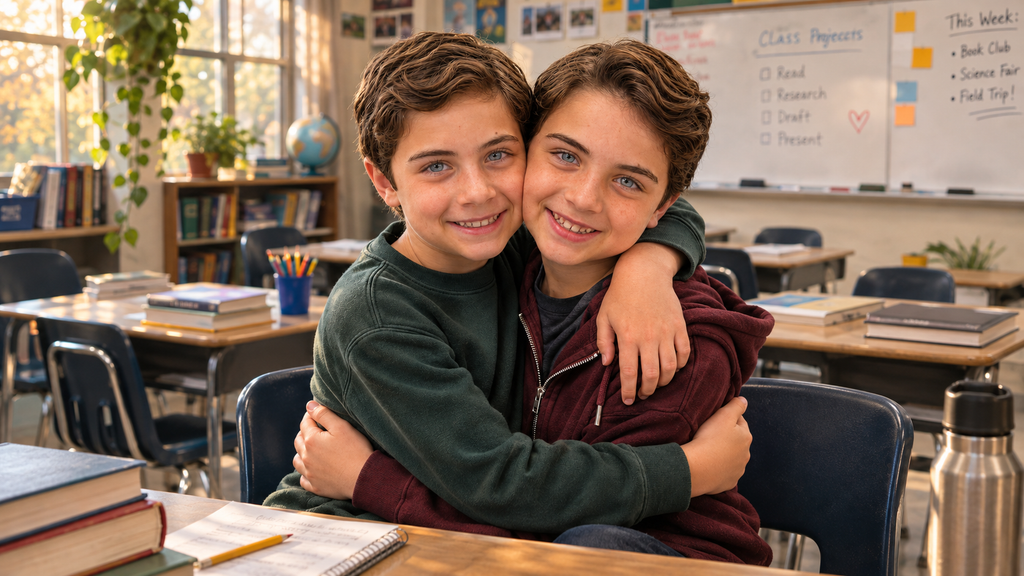
The man who had kissed my forehead and whispered, “You have to let him go, sweetheart.”
Now he stood behind a strange woman, staring at the two boys in the principal’s office as though the floor had disappeared beneath his feet.
I looked at him.
Then at Stefan.
Then back at Mark.
And suddenly, a terrible possibility began forming in my mind.
“Mark?”
My voice sounded unfamiliar.
He opened his mouth.
Nothing came out.
The woman in front of him turned around.
“Mark? What’s wrong?”
I felt something cold move through my chest.
She knew him.
Not as a stranger.
Not as someone she had just met in the hallway.
She said his name with the comfortable familiarity of someone who had said it thousands of times.
The principal cleared his throat.
“Mr. Bennett, I’m glad you’re here. We were just discussing the incident between the boys.”
Mark didn’t answer.
His eyes were fixed on me.
I took one step toward him.
“Why are you here?”
He swallowed.
“Emily, I can explain.”
Those four words.
I would come to hate those four words more than anything else he ever said to me.
Because people who have done nothing wrong rarely begin with I can explain.
The woman looked between us.
“Wait,” she said slowly. “You know each other?”
I laughed.
It wasn’t a happy laugh.
It was the sound of something breaking.
“Yes,” I whispered. “We know each other.”
I pointed at Mark.
“He’s my husband.”
The woman went completely still.
Her fingers loosened around her handbag.
“What?”
“He’s my husband,” I repeated.
The silence that followed seemed to swallow the entire room.
Then the woman whispered something I would never forget.
“But he’s my husband, too.”
For several seconds, nobody moved.
The principal looked as though he wanted to disappear behind his desk.
Cole stared at me.
Stefan stared at Mark.
And Mark stood between two women and two little boys, wearing the expression of a man who had finally reached the end of a road he thought would never end.
I looked at the woman.
“What’s your name?”
She blinked.
“Rachel.”
“Rachel what?”
“Rachel Bennett.”
Bennett.
My married name.
I felt my knees weaken.
“How long?” I asked.
Rachel looked confused.
“How long what?”
“How long have you been married to him?”
She glanced at Mark.
He shook his head almost imperceptibly.
I saw it.
So did she.
“Mark?” she whispered.
I stepped between them.
“Don’t look at him. Look at me.”
My voice was trembling now.
“How long have you been married?”
Rachel’s eyes filled with tears.
“Seven years.”
Seven years.
I had been married to Mark for eleven.
For seven of those years, he had apparently been living another life.
Another house.
Another wife.
Another child.
I turned toward him.
“Tell me she’s lying.”
Mark rubbed his forehead.
“Emily, please. Not in front of the boys.”
“Tell me she’s lying!”
My shout made Cole flinch.
Immediately, I regretted it.
I turned toward my son.
He was sitting in the chair with his hands folded tightly in his lap.
His lower lip trembled.
“Mom?”
I knelt in front of him.
“Sweetheart, I’m sorry.”
“Is Dad Stefan’s dad?”
I couldn’t answer.
Because I didn’t know what was worse.
That Mark might have another son.
Or that the other son might be the baby I had spent eight years mourning.
Cole looked past me.
“Dad?”
Mark finally spoke.
“Buddy, this is complicated.”
Cole’s expression changed.
He was only eight years old.
But even at eight, children know when adults are hiding something terrible.
“No,” Cole said quietly. “It’s not complicated.”
He pointed at Stefan.
“He looks like me.”
Then he asked the question that would follow me into every nightmare for months.
“Did you tell Mom her baby died when he didn’t?”
Mark closed his eyes.
And that was the moment I knew.
Not because he confessed.
Not because anyone showed me a document.
But because my husband, who had always been able to invent an explanation for anything, couldn’t look at his own child.
Rachel grabbed the back of a chair.
“Mark,” she said, her voice rising, “what is he talking about?”
Mark turned toward her.
“Rachel, please calm down.”
“Don’t tell me to calm down!”
Her voice cracked.
“You told me Emily was your sister!”
I stared at her.
My sister.
For seven years, the woman who had been sleeping beside my husband believed I was his sister.
I had never even heard her name.
Rachel looked at me with horror.
“He told me you were a widow,” she whispered. “He said you were raising your little boy alone.”
I felt the room tilt.
Mark had shown her photographs of me.
Of Cole.
He had introduced my existence into his other life.
But he had changed my identity.
I wasn’t his wife.
I was his poor widowed sister.
And my son wasn’t his son.
He was his nephew.
“Why?” I asked.
Mark stared at the floor.
“Emily—”
“Why would you tell another woman I was your sister?”
He said nothing.
Rachel suddenly moved toward Stefan.
“Come here, baby.”
But Stefan didn’t move.
He was looking at me.
At my eyes.
At my trembling hands.
Then he asked softly, “Are you Cole’s mom?”
I nodded.
“Yes, sweetheart.”
He looked at Cole.
Then back at me.
“Mark said Cole’s mom was sick.”
I couldn’t breathe.
“What?”
“He said you were sick when we were babies.”
My heart began pounding so violently that I could hear it.
“What else did he tell you?”
Stefan hesitated.
“That you couldn’t take care of both of us.”
The room went silent.
I looked at Mark.
“What did you just say?”
Stefan lowered his eyes.
“Sorry.”
I reached toward him, then stopped myself.
“No, sweetheart. You didn’t do anything wrong.”
I looked directly at my husband.
“Mark. What did you tell this child?”
He finally lifted his head.
His eyes were wet.
“Emily, you have to understand what happened back then.”
I stood.
“Then tell me.”
He looked at the principal.
“Can we have some privacy?”
I shook my head.
“No.”
“Emily—”
“No more private conversations. No more whispered explanations. No more secrets.”
My voice grew steadier with every word.
“For eight years, I have cried over a child you told me was dead.”
Mark’s face crumpled.
I stepped closer.
“Is Stefan my son?”
He didn’t answer.
“Look at me.”
He did.
And then, barely above a whisper, he said:
“Yes.”
I had imagined finding my lost baby a thousand times.
In those dreams, I would hear him crying.
I would reach into a hospital bassinet.
I would lift him against my chest.
And someone would tell me there had been a mistake.
That he was alive.
That I could take him home.
But I had never imagined discovering him eight years later in a school principal’s office, with a bruise on his cheek and a father who had lied to everyone.
I turned toward Stefan.
He was watching me with frightened gray eyes.
My eyes.
Cole’s eyes.
The eyes I had inherited from my mother.
I took one step toward him.
Then another.
“Stefan?”
He nodded.
I knelt so that we were face-to-face.
“Can I ask you something?”
“Okay.”
“How old are you?”
“Eight.”
“When is your birthday?”
He told me.
March seventeenth.
The same day as Cole.
The same day I had almost died giving birth.
My hands flew to my mouth.
“And what time were you born?”
He frowned.
“I don’t know.”
I tried to smile.
“That’s okay.”
He studied my face.
Then he looked at Cole.
“See?” he whispered.
Cole frowned.
“See what?”
Stefan’s voice trembled.
“I told you we were brothers.”
Something inside me broke open.
I reached toward him again.
This time, I gently touched his cheek.
He didn’t pull away.
His skin was warm.
Real.
Alive.
Eight years of grief had taught me to imagine what my lost child might have looked like.
Would he have Cole’s eyes?
Would he have my nose?
Would he laugh like his father?
Now he was sitting in front of me.
And I didn’t even know his favorite food.
I didn’t know whether he was afraid of thunderstorms.
I didn’t know what song helped him fall asleep.
I didn’t know whether he had ever been sick.
Whether he liked bedtime stories.
Whether he had cried for someone to hold him.
I had missed his first word.
His first step.
His first day of school.
I had missed eight birthdays.
Eight Christmas mornings.
Eight years of goodnight kisses.
I whispered, “My baby.”
Stefan’s eyes widened.
Behind me, Rachel began to cry.
And Mark said something so cruel that I still remember the exact sound of his voice.
“Emily, don’t confuse him.”
I turned around.
“Confuse him?”
Mark took a step back.
“He’s had a good life.”
A good life.
As though that made what he had done acceptable.
As though a stolen childhood could be justified by the quality of the furniture in someone else’s house.
I stood slowly.
“You don’t get to tell me what he has had.”
Then I looked at Rachel.
“And you don’t get to tell me what he needs.”
Rachel wiped her face.
“I didn’t know.”
I stared at her.
“I swear to you,” she said. “I didn’t know.”
For the first time since she had entered the office, I believed her.
Because she looked exactly the way I felt.
Like someone had opened a door beneath her feet.
The principal finally intervened.
“Mrs. Bennett, I think we need to slow down.”
I turned toward him.
“My son is sitting in that chair.”
He nodded carefully.
“I understand what you’re saying, but there are legal and safety considerations here.”
“Then call someone who can help us.”
He reached for the phone.
Mark immediately moved forward.
“That isn’t necessary.”
I looked at him.
“Why?”
“We can work this out as a family.”
I almost laughed.
“A family?”
He nodded desperately.
“Emily, please.”
I stepped away from him.
“You had eight years to work this out.”
Then I took out my phone.
I called the police.
Mark lunged toward me.
“Emily, don’t!”
I stepped back.
“Don’t touch me.”
The principal rose from his chair.
“Mr. Bennett, sit down.”
For a moment, I thought Mark might refuse.
Then he looked at the two boys.
At their frightened faces.
And slowly lowered himself into a chair.
I told the dispatcher that I had reason to believe my husband had concealed the survival and identity of one of my twin sons after a premature birth.
I gave the school address.
I explained that both boys were present.
The dispatcher told me officers would come and advised us to remain calm and keep everyone safe.
Calm.
I remember staring at that word in my mind.
How was I supposed to remain calm when my dead baby was sitting ten feet away?
The officers arrived twenty minutes later.
By then, Rachel and I were sitting on opposite sides of the office.
Mark had stopped speaking.
Cole sat beside me.
Stefan sat beside Rachel.
Every few seconds, the boys looked at each other.
The first officer introduced herself as Officer Daniels.
Her partner was Officer Reyes.
They listened to the principal.
Then to me.
Then to Rachel.
Finally, Officer Daniels looked at Mark.
“Sir, we’re going to need to establish some facts.”
Mark nodded.
“Of course.”
“Are you legally married to Mrs. Emily Bennett?”
“Yes.”
“Are you also legally married to Mrs. Rachel Bennett?”
He hesitated.
Rachel stared at him.
“Answer her.”
Mark rubbed his hands together.
“Rachel and I had a ceremony.”
Officer Daniels waited.
“Was there a marriage license?”
“I don’t remember the details.”
Rachel made a wounded sound.
“What do you mean, you don’t remember?”
Mark didn’t look at her.
Officer Daniels continued.
“Are you the biological father of both boys?”
Mark nodded.
“Yes.”
“And is Mrs. Emily Bennett the biological mother of both boys?”
He stared at the floor.
“Yes.”
Rachel began sobbing again.
Officer Daniels looked toward Stefan.
“Was Mrs. Rachel Bennett aware of this?”
“No,” Rachel answered before Mark could speak.
“I thought Stefan was my adopted son.”
My head snapped toward her.
“Adopted?”
Rachel nodded.
Her face had gone gray.
“Mark told me Stefan’s birth mother had died.”
I gripped the arms of my chair.
“Show me.”
Rachel looked confused.
“What?”
“Show me the adoption papers.”
She opened her handbag with shaking fingers.
She pulled out her phone.
Scrolled.
Then handed it to Officer Daniels.
“There,” she whispered. “That’s what Mark sent me before we got married.”
The officer studied the screen.
Her expression changed.
She looked at her partner.
“Can you take a look at this?”
He leaned closer.
Neither spoke for several seconds.
Then Officer Daniels asked Mark:
“Who prepared these documents?”
Mark said nothing.
“Sir?”
“A lawyer.”
“Which lawyer?”
“I don’t remember.”
Officer Daniels looked at him for a long moment.
Then she said:
“Mr. Bennett, I think it’s important that you stop guessing.”
That afternoon, I learned the first piece of the truth.
But not the whole truth.
Not even close.
The officers separated us for interviews.
The principal arranged for the boys to sit in a quiet room with the school counselor.
Before they left, Stefan approached me.
He looked nervous.
“Are you mad at me?”
I crouched in front of him.
“No, sweetheart.”
“Because I kept telling Cole.”
I shook my head.
“Why did you keep telling him?”
He glanced at Mark.
Then lowered his voice.
“Because I heard Dad talking.”
My heart stopped.
“When?”
“At home.”
“What did you hear?”
Stefan looked toward the hallway.
“He was on the phone.”
“Who was he talking to?”
“I don’t know.”
“What did he say?”
Stefan swallowed.
“He said, ‘They can’t ever find out which one I gave away.’”
I stared at him.
Which one.
Not the baby.
Not Stefan.
Which one.
As though my children had been interchangeable.
As though he had chosen between them.
Stefan continued.
“I asked him what that meant.”
“What did he say?”
“He got mad.”
His little shoulders tightened.
“He told me I was imagining things.”
I reached for his hand.
“You weren’t imagining things.”
Stefan looked at me.
Then he whispered:
“I think he was scared of me.”
That sentence hurt more than anything else.
Because a child should never believe his own father is afraid of him for knowing the truth.
By evening, the school had become a blur of statements, phone calls, and quiet conversations.
A child welfare investigator arrived.
The officers explained that the case would require hospital records, birth certificates, adoption documents, and likely DNA testing.
There would be no instant solution.
No dramatic moment where someone simply handed Stefan to me and said he was mine.
He was a child with a life.
A home.
A mother he loved.
And a history built on lies.
The law would have to determine how those lies had happened.
The investigator, Ms. Parker, spoke gently.
“Mrs. Bennett, I know you want answers tonight.”
“I want my son.”
“I understand.”
“No,” I whispered. “I don’t think you do.”
She let the silence settle.
Then she said something that stayed with me.
“Finding him is the beginning. We have to make sure what happens next doesn’t hurt him more.”
I looked through the glass window.
Stefan was sitting beside Cole.
They were drawing on the same sheet of paper.
For the first time that afternoon, neither boy looked angry.
They looked curious.
Like two pieces of a puzzle trying to understand why they fit.
I nodded.
“Then tell me what I need to do.”
That night, Mark did not come home.
I had been advised not to confront him alone while the investigation was beginning.
I took Cole home.
He barely spoke during the drive.
Usually, he would tell me about school.
About his friends.
About whatever game he was obsessed with that week.
That evening, he stared out the window.
When we reached our driveway, he finally asked:
“Mom?”
“Yes, baby?”
“Did Dad steal Stefan?”
My hands tightened around the steering wheel.
I turned off the engine.
“I don’t know everything yet.”
“But you think he did.”
I looked at my son.
His face was so familiar.
And now that I had seen Stefan, it felt incomplete without the other half.
“I think Dad told us something that wasn’t true.”
Cole nodded slowly.
Then he asked:
“Did you love Stefan before you knew him?”
My eyes filled.
“Oh, sweetheart.”
I reached across the seat.
“I loved both of you before I ever saw your faces.”
He thought about that.
Then whispered:
“Does that mean you love me less now?”
I felt my heart crack.
I unbuckled my seat belt and pulled him into my arms.
“Never.”
He clung to me.
“Promise?”
“I promise.”
I kissed his hair.
“Love isn’t a cake, Cole. Giving someone another piece doesn’t make yours smaller.”
He was quiet for a moment.
Then he said:
“Okay.”
I held him tighter.
And for the first time all day, I cried.
Not because of Mark.
Not because of the lies.
But because my eight-year-old son was afraid that finding his brother meant losing his mother.
After Cole fell asleep, I went into the bedroom I had shared with Mark for eleven years.
Everything looked ordinary.
His watch sat on the dresser.
His shoes were beneath the chair.
A half-read book rested on his nightstand.
The room smelled faintly of his cologne.
I stood in the doorway and wondered how a person could live beside you for so long and still remain a stranger.
Then I noticed something.
The bottom drawer of his nightstand was slightly open.
Mark was meticulous.
He hated drawers left open.
I pulled it out.
Inside were old receipts.
A spare charger.
A pair of sunglasses.
And a small black notebook.
I almost put it back.
Then I saw a date written on the first page.
March 17.
Eight years earlier.
The day my twins were born.
My fingers began trembling.
I sat on the bed.
Opened the notebook.
And found a list of numbers.
Hospital room numbers.
Insurance information.
Names.
One name had been circled three times.
Dr. Leonard Price.
The obstetrician who had delivered my babies.
The doctor who had told me afterward that the second twin had suffered complications.
The doctor who had stood beside Mark while my husband explained why I couldn’t see the body.
Under his name, Mark had written:
Payment completed.
I stared at the words.
Then turned the page.
There was another sentence.
Rachel must never know Emily survived.
I read it once.
Twice.
Three times.
My stomach turned.
Rachel must never know Emily survived.
Not that the baby survived.
That I survived.
I slowly lowered the notebook.
And suddenly I understood something horrifying.
Mark hadn’t simply hidden my child.
He had built his entire second life around the possibility that I might die.
The next morning, I called an attorney.
Her name was Sarah Whitmore.
She specialized in family law and complex custody cases.
When I finished explaining what had happened, she was silent for several seconds.
Then she said:
“Emily, I need you to listen carefully.”
“I’m listening.”
“Do not confront your husband with anything else you’ve found. Preserve the notebook exactly as it is. Photograph it, and we’ll coordinate with the investigators about the original.”
“Okay.”
“And I want you to gather every medical document you have from the delivery.”
“I have a box.”
“Bring it.”
I looked toward the hallway.
Cole was still asleep.
“Sarah?”
“Yes?”
“What if they tell me I can’t have him?”
She didn’t give me a comforting lie.
She said:
“We’re going to establish the truth first. Then we’ll fight for a safe, lawful arrangement that protects both boys.”
I closed my eyes.
“All right.”
Then she added:
“Emily, one more thing.”
“What?”
“If the documents are what they appear to be, your husband may not be the only person who needs to answer questions.”
I found the hospital box in the attic.
It was covered in dust.
For years, I had avoided opening it.
Inside were the things I couldn’t bear to throw away.
A tiny blue knitted hat.
Two hospital wristbands.
A photograph of me holding Cole.
A folded blanket.
And an envelope containing discharge papers.
I sat on the attic floor and spread everything around me.
My hands were shaking.
There were two infant identification bands.
I had always known that.
One had belonged to Cole.
The other to the baby I believed had died.
I lifted the second band.
The ink was faded.
But I could still read the number.
Baby B.
I turned it over.
And noticed something I had never seen before.
There was a small handwritten letter beside the identification number.
An R.
I frowned.
Then I looked at Cole’s band.
Beside his number was a C.
I had always assumed the letters were hospital codes.
But now I wondered.
R.
Rachel?
C.
Cole?
My mind raced.
I photographed both bands and sent the images to Sarah.
Then I opened the discharge papers.
There were six pages.
I had never read them carefully.
I had been grieving.
Exhausted.
Medicated.
And trusting.
On the third page, I found a line that made me stop breathing.
Twin B transferred to neonatal intensive care.
Transferred.
Not deceased.
Transferred.
I turned the page.
There was no death certificate.
No recorded time of death.
No documentation of a funeral home.
Only a note:
Further disposition to be confirmed by attending physician.
I stared at those words.
Eight years.
For eight years, I had believed my child died.
And the paperwork in my attic had never actually said that.
I pressed the papers against my chest.
Then I screamed.
It was a sound I didn’t recognize.
A sound that came from somewhere deeper than grief.
It came from the part of me that had trusted the wrong person with the most precious thing I had ever carried.
Three days later, Sarah called.
“Emily, we found something.”
I was standing in the kitchen.
Cole was at school.
I gripped the counter.
“What?”
“The hospital has confirmed that both babies were born alive.”
I closed my eyes.
Even though I already knew, hearing it officially felt like being struck.
“Both?”
“Yes.”
“And Stefan?”
“We’re still waiting on the DNA results. But there’s more.”
I sat down.
Sarah’s voice became careful.
“Your hospital was acquired by another healthcare group four years ago. Some records were archived. Investigators have requested the complete file.”
“Okay.”
“An initial review shows that Twin B remained in the neonatal unit for eleven days.”
Eleven days.
My son had lived eleven days in the same hospital where I was recovering.
Eleven days when I could have touched him.
Held him.
Fed him.
Sung to him.
I had spent those days believing he was dead.
“Emily?”
I couldn’t speak.
“Are you still there?”
“Yes.”
Sarah waited.
Then I whispered:
“Did he cry?”
“What?”
“Did my baby cry?”
Sarah’s voice softened.
“I don’t know.”
I covered my mouth.
“Was he alone?”
“I don’t know, Emily.”
I looked at the photograph on my refrigerator.
Cole at his seventh birthday party.
Mark smiling beside him.
Me holding the cake.
A happy family.
Or what I had believed was one.
“Find out,” I whispered.
“Please find out if someone held him.”
The DNA results came back six days later.
Sarah asked me to come to her office.
I knew before she opened the folder.
I knew from the way she looked at me.
But I still needed to hear it.
“Emily,” she said, “the results confirm that Stefan is your biological son.”
I pressed both hands against my mouth.
Sarah continued.
“He and Cole are genetically consistent with identical twins.”
Identical.
My two boys.
The same heartbeat once divided between two tiny bodies.
Separated before they had even learned to open their eyes.
I began crying.
Not quietly.
Not politely.
I cried the way I had cried eight years earlier when Mark told me one of my babies was gone.
But this time, grief was tangled with something else.
Relief.
Rage.
Hope.
Fear.
Sarah slid a tissue box toward me.
I shook my head.
“I don’t understand.”
She waited.
“How could someone do this?”
She looked down at the documents.
“We’re beginning to understand that.”
My heart began pounding again.
“What do you mean?”
Sarah took a breath.
“The investigators have identified irregularities in the transfer records. A former hospital administrator has agreed to be interviewed.”
“Who?”
“Margaret Ellis.”
The name meant nothing to me.
Until Sarah showed me a photograph.
A woman in blue scrubs.
Silver hair.
Kind eyes.
And suddenly I remembered.
A nurse.
She had stood beside my hospital bed the morning I woke up.
She had held my hand while I asked where my second baby was.
And she had cried.
I remembered that.
I remembered thinking she was crying because my baby had died.
Now I wondered if she had been crying because she knew he hadn’t.
Margaret Ellis lived in a small house outside town.
Investigators interviewed her before I was allowed to speak with her.
When Sarah finally arranged a supervised meeting, I almost couldn’t walk through the door.
Margaret was older now.
Her hair was completely white.
She sat at a kitchen table with a cup of tea she hadn’t touched.
The moment she saw me, she began to cry.
“Emily.”
I stood in the doorway.
“You remember me?”
She nodded.
“Every day.”
I felt a chill.
“Why?”
Margaret looked at Sarah.
Sarah gave a small nod.
Margaret folded her hands.
“I was the neonatal unit’s administrative supervisor when your boys were born.”
I sat across from her.
“Tell me what happened.”
Her lips trembled.
“Your delivery was very difficult. You lost a great deal of blood. There were complications, and you needed intensive care.”
“I know.”
“Both boys were born alive. Both needed respiratory support. Twin B was smaller and had more complications.”
“Stefan.”
Margaret nodded.
“Yes.”
I leaned forward.
“Why did everyone tell me he died?”
She stared at her hands.
“Because the records were changed.”
The room went silent.
“Who changed them?”
Margaret closed her eyes.
“Dr. Price approved the false entries. I helped process some of the paperwork.”
I stared at her.
“You?”
She began crying harder.
“I was told there was an emergency placement.”
“What emergency?”
She shook her head.
“Your husband said you were unstable. That you had experienced a severe psychiatric episode. He claimed you had agreed before surgery that if both children survived, one would be placed for adoption.”
I felt sick.
“I never agreed to that.”
“I know that now.”
“You knew it then.”
Margaret looked up.
Her eyes were full of shame.
“I suspected it.”
I stood so quickly that my chair scraped against the floor.
“You suspected?”
Sarah touched my arm.
“Emily.”
I pulled away.
“My son was alive for eleven days, and you let them take him!”
Margaret covered her face.
“I know.”
“You could have told me!”
“I know.”
“You could have walked into my room!”
“I know!”
Her voice broke.
“I should have.”
The silence afterward was unbearable.
Finally, Margaret whispered:
“I have spent eight years trying to find a way to make this right.”
I stared at her.
“Then why didn’t you?”
She looked toward the window.
“Because I was afraid.”
I laughed bitterly.
“Afraid of what?”
“Of losing my job. Of going to prison. Of what Dr. Price would do.”
I looked at her.
“And my baby?”
She began crying again.
I shook my head.
“You were afraid of losing your life.”
I leaned closer.
“So you helped destroy mine.”
Margaret told us the rest.
Dr. Price had been under financial pressure.
Mark had known him socially for years.
They had played golf together.
Attended charity dinners.
Their wives had met at hospital fundraisers.
At least, one of Dr. Price’s wives had met me.
I would later discover he knew about Rachel, too.
According to Margaret, Mark had approached Dr. Price before the twins were born.
He had said our marriage was failing.
He claimed I was mentally unstable.
He said he was afraid I might harm the babies.
None of it was true.
But he had prepared the story carefully.
When I went into premature labor, Mark saw an opportunity.
The emergency created confusion.
I was unconscious.
The babies were in intensive care.
And Mark had access to the people responsible for the records.
Margaret said she had been told that a private adoption had been arranged.
She was shown papers bearing my signature.
A signature I had never written.
When she questioned it, Dr. Price told her the documents had been signed before delivery.
She wanted to believe him.
So she did.
That was the part I struggled with most.
Not that evil people had done evil things.
But that ordinary people had looked at something suspicious and chosen not to ask questions.
Margaret had seen me crying.
She had heard me begging to see my child.
And she had remained silent.
I asked her one final question.
“Did you hold him?”
She looked up.
“What?”
“My baby.”
My voice broke.
“During those eleven days. Did you hold him?”
Margaret’s face changed.
For the first time, something gentle appeared in her expression.
“Yes.”
I covered my mouth.
“He was very small,” she whispered. “But he was strong.”
I began crying.
“He had a habit of curling his left hand into a fist. The nurses used to joke that he was ready to fight the world.”
I thought of Stefan sitting in the principal’s office.
The bruise on his cheek.
His stubborn insistence that Cole was his brother.
I almost smiled through my tears.
“That sounds like him.”
Margaret nodded.
“He cried when the room got too quiet. One of the nurses would hum to him.”
“What song?”
Margaret closed her eyes.
“‘You Are My Sunshine.’”
My breath caught.
It was the song I sang to Cole every night when he was a baby.
The same song my mother had sung to me.
I looked down at my hands.
For eight years, I had imagined my lost son alone in the dark.
Now I knew that, at least sometimes, someone had held him.
Someone had sung to him.
It didn’t excuse what happened.
But it gave my grief one small place to rest.
The investigation widened.
Dr. Price was questioned.
Financial records were examined.
The adoption documents were scrutinized.
And Mark’s carefully constructed life began to unravel.
Rachel called me one evening.
I almost didn’t answer.
But something made me pick up.
“Emily?”
Her voice sounded exhausted.
“Yes.”
“Can we talk?”
I looked at Cole, who was doing homework at the kitchen table.
“About what?”
“Stefan.”
My chest tightened.
“Is he okay?”
“He’s confused.”
I closed my eyes.
“So is Cole.”
Rachel was quiet.
Then she said:
“He asked me if I’m still his mom.”
I felt tears rise.
“What did you tell him?”
“I told him yes.”
I swallowed.
“Good.”
Rachel began crying.
“Emily, I know you hate me.”
I looked out the window.
“I don’t know you well enough to hate you.”
She was silent.
Then I added:
“But I know you love him.”
Rachel’s breath caught.
“More than anything.”
“I can see that.”
She cried harder.
“I didn’t steal him.”
“I know.”
“I thought his mother was dead.”
“I know.”
She took a shaky breath.
“Mark told me he was a widower when we met. He said his first wife died after childbirth.”
I closed my eyes.
“He told you I died?”
“Yes.”
“And then he told you I was his sister?”
Rachel hesitated.
“At first, he said the woman in the photographs was his late wife. Later, when I saw you at a school event years ago, he told me you were his sister and that I had misunderstood the old pictures.”
I felt sick.
He had changed the story whenever he needed to.
And Rachel had believed him because she loved him.
Just as I had.
She continued.
“Stefan knows something is wrong. He keeps asking when he can see Cole.”
I looked toward my son.
He was pretending to work.
But I knew he was listening.
I lowered my voice.
“Rachel, I don’t want to take away the only mother he’s ever known.”
She began sobbing.
“Thank you.”
“But I can’t lose him again.”
“I know.”
We sat in silence.
Two women who should have been enemies.
Two mothers who had loved the same little boy from opposite sides of a lie.
Finally, Rachel whispered:
“What do we do?”
I looked at Cole.
Then at the photograph of my twins’ hospital wristbands on my phone.
“We tell them the truth.”
The first meeting between the boys outside school took place two weeks later.
A family therapist helped arrange it.
Rachel and I sat in a room with soft chairs and shelves full of toys.
Cole and Stefan sat across from each other.
For a long time, neither spoke.
Then Stefan pulled something from his backpack.
A small red toy car.
He placed it on the table.
Cole stared.
“Where did you get that?”
Stefan shrugged.
“Had it forever.”
Cole reached into his own backpack.
He pulled out a nearly identical blue car.
I felt my heart squeeze.
Mark had bought Cole that car when he was three.
Apparently, he had bought Stefan the matching one.
The boys looked at the cars.
Then at each other.
Stefan smiled.
“Mine’s faster.”
Cole snorted.
“No way.”
“Yes way.”
“Prove it.”
Within minutes, they were racing the cars across the carpet.
Laughing.
Arguing.
Cheating.
Accusing each other of cheating.
And then laughing again.
Rachel sat beside me.
Her hands were clasped tightly.
I could see she was fighting tears.
So was I.
The therapist watched quietly.
After a while, Cole looked up.
“Mom?”
“Yes?”
“Can Stefan come over sometime?”
I glanced at Rachel.
She nodded.
I smiled.
“We’ll work that out.”
Stefan looked at me.
“Can I call you Emily?”
The question hurt.
But I understood.
I was his biological mother.
Not yet the woman who had tucked him into bed every night.
Not yet the woman he reached for when he had a nightmare.
I smiled.
“Of course.”
He thought for a moment.
“Okay, Emily.”
Then he returned to racing cars.
And I learned something important.
Love didn’t always arrive with a dramatic embrace.
Sometimes it began with a child feeling safe enough to call you by your first name.
A month later, Sarah called me into her office again.
This time, her expression was different.
Serious.
Almost frightened.
“Emily, there’s something else.”
I felt my stomach drop.
“What?”
She placed a folder on the desk.
“The financial investigation has uncovered a payment made shortly before the twins were born.”
“To Dr. Price?”
“Yes.”
“How much?”
“Forty thousand dollars.”
I stared at her.
Mark had told me we were struggling financially that year.
He had asked me to postpone buying a larger house.
He had said we needed to save every penny for the babies.
Forty thousand dollars.
“What was it for?”
Sarah looked at me carefully.
“Investigators believe it was connected to the fraudulent adoption arrangement.”
I closed my eyes.
Then she said:
“But there’s another transaction.”
I opened them.
“What?”
“A transfer into an account held by Mark, shortly after Stefan left the hospital.”
“How much?”
“Two hundred and fifty thousand dollars.”
I couldn’t speak.
Sarah continued.
“The source appears to be a trust connected to Rachel’s family.”
I stared at her.
“Rachel’s family?”
Sarah nodded.
“Her father established a trust years ago. It included a provision for a child legally adopted into the family.”
I felt the room spin.
Mark hadn’t simply wanted another family.
He had wanted access to money.
I whispered:
“He sold my son?”
Sarah leaned forward.
“We need to be precise. Investigators are examining whether he used fraudulent adoption documents to obtain a financial benefit. The legal findings aren’t complete.”
But in my heart, the distinction felt very small.
My husband had taken my child.
Given him to another woman.
And received money connected to that arrangement.
I sat in silence for a long time.
Then I asked:
“Did Rachel know?”
“There’s no evidence that she did.”
I nodded slowly.
Of course she hadn’t.
Mark had chosen a woman who wanted a child.
A woman who believed she was giving a motherless baby a home.
He had used her longing the same way he had used my grief.
I looked at Sarah.
“Does Rachel know about the money?”
“Not yet.”
I took a deep breath.
“Then she needs to.”
Rachel came to my house the following evening.
It was the first time she had ever been there.
She stood on the porch holding a plate of cookies.
I almost smiled.
It was such an ordinary thing to bring.
Cookies.
As though we were neighbors meeting for coffee.
As though our lives hadn’t been shattered by the same man.
“Hi,” she said.
“Hi.”
I stepped aside.
She entered slowly.
Her eyes moved around the living room.
The family photographs.
The children’s books.
The framed picture of Cole on his first day of kindergarten.
Then she stopped in front of a photograph of Mark and me on our wedding day.
Her face crumpled.
“He told me that was his brother’s wedding.”
I looked at the picture.
Mark was smiling.
His arm was around my waist.
I was wearing my mother’s pearl earrings.
I had believed I was marrying my best friend.
Rachel touched the frame.
“He showed me this photo once.”
I swallowed.
“Did he?”
She nodded.
“He said you were his sister-in-law.”
I stared at her.
Another story.
Another lie.
Rachel turned toward me.
“How many versions of you did he invent?”
I shook my head.
“I don’t know.”
We sat at the kitchen table.
I made tea.
Neither of us drank it.
Then I told her about the money.
She stared at me.
“No.”
I slid the documents across the table.
Her hands began shaking.
“No,” she repeated.
I said nothing.
She read the pages.
Then covered her mouth.
“My father.”
I nodded.
Rachel began crying.
“He told Dad that Stefan needed expensive medical care.”
I felt cold.
“What?”
“He said there had been complications after the adoption. That there were legal fees and medical bills.”
She stared at the documents.
“Dad transferred the money because he thought he was helping his grandson.”
I closed my eyes.
Mark had lied to everyone.
But the worst part was still coming.
Rachel looked at me.
“Emily, there’s something I need to tell you.”
I opened my eyes.
“What?”
She took a shaky breath.
“Three months ago, Mark asked me to sign a new life insurance policy.”
My heart stopped.
“On whom?”
She looked at me.
“Stefan.”
I stared at Rachel.
“What kind of policy?”
She wiped her cheeks.
“A large one. He said it was part of financial planning.”
“How large?”
“One million dollars.”
The kitchen went silent.
I felt a terrible coldness spread through me.
“Did you sign it?”
“No.”
“Why not?”
Rachel looked down.
“Because it felt wrong.”
I waited.
“He got angry when I questioned it. He said I didn’t understand finances.”
She looked at me.
“I told him I wasn’t comfortable putting that much insurance on a child.”
I gripped the edge of the table.
“Did he ever mention Cole?”
Rachel nodded slowly.
“He asked whether you had life insurance on Cole.”
My stomach twisted.
“When?”
“A few weeks before the school fight.”
I looked toward the hallway.
Cole was at my sister’s house for the evening.
Safe.
But suddenly, the walls of my home felt too thin.
Rachel reached across the table.
“Emily, I don’t know what he was planning.”
Neither did I.
And that was what frightened me.
I called Sarah immediately.
She told me to preserve Rachel’s messages and policy documents and to share the information with investigators.
She also helped us arrange a safety plan.
No unsupervised contact with Mark until the appropriate authorities and court could evaluate the risks.
No private meetings.
No surprise visits.
No trusting his promises.
For the first time, Rachel and I were working together.
Not because we had forgiven each other.
There was nothing for us to forgive.
But because two little boys needed adults who would finally tell the truth.
Mark called me that night.
I almost ignored it.
Then I remembered Sarah’s advice to preserve any communications.
I answered and put the phone on speaker.
“Emily.”
His voice sounded tired.
“What do you want?”
“I want to see Cole.”
“Speak to Sarah.”
He sighed.
“You’re really going to do this?”
I stared at the phone.
“Do what?”
“Destroy our family.”
I laughed.
A short, disbelieving laugh.
“Mark, you destroyed our family eight years ago.”
“That’s not fair.”
“Fair?”
I stood.
“Do you want to talk about fair?”
He was silent.
“Was it fair when I woke up in that hospital and asked for my baby?”
“Emily—”
“Was it fair when you held me while I cried?”
He said nothing.
“Was it fair when I begged you to tell me where he was buried?”
His breathing changed.
I remembered that night.
Six months after the delivery.
I had asked Mark to take me to the cemetery.
I wanted to put flowers on my baby’s grave.
He told me there was no grave.
That the hospital had handled everything.
That it had been too painful for him to arrange a burial.
I had apologized.
I had apologized to the man who had stolen my child.
My voice broke.
“Do you remember what you told me?”
Mark whispered:
“Emily, please.”
“You said I needed to stop living in the past.”
He began crying.
I felt nothing.
Not satisfaction.
Not pity.
Only exhaustion.
“Why?” I asked.
He was quiet.
“Why did you choose Stefan?”
His breathing stopped.
“What?”
“Why did you take him instead of Cole?”
Silence.
Then Mark whispered:
“Because he was smaller.”
I closed my eyes.
He continued.
“Dr. Price said he might have medical problems. I thought…”
He stopped.
“You thought what?”
“I thought it would be easier.”
I felt sick.
“Easier for whom?”
He didn’t answer.
I waited.
Finally, he whispered:
“For everyone.”
I stared at the wall.
My husband had looked at two newborn sons.
One stronger.
One smaller.
And decided the smaller one was easier to give away.
I whispered:
“You didn’t choose between two babies.”
Mark was silent.
“You chose between two lives you wanted to live.”
He began sobbing.
“I made a mistake.”
I shook my head.
“No.”
My voice was calm now.
“A mistake is forgetting a birthday.”
I looked at the photograph of my sons on the refrigerator.
“What you did was a choice.”
Then I ended the call.
Two days later, Mark was arrested.
The investigation had uncovered evidence of forged documents, fraudulent financial transactions, and a coordinated effort to conceal Stefan’s identity.
Dr. Price was also charged.
Margaret Ellis cooperated with investigators and later faced consequences for her own role.
The criminal case would take time.
There were hearings.
Attorneys.
Evidence.
Arguments.
Delays.
Nothing about the legal process was as quick or satisfying as television makes it look.
But one thing was finally certain.
Mark could no longer control the story.
For eight years, he had been the only person allowed to explain what happened.
Now the documents were speaking.
The witnesses were speaking.
And the two women he had deceived were speaking together.
The first time I visited Stefan at Rachel’s house, I stood outside the door for almost five minutes.
I had brought a small gift.
A book about dinosaurs.
Rachel had told me he loved them.
I wanted to bring something bigger.
A bicycle.
A gaming console.
Eight years of birthday presents.
But the therapist had advised me not to overwhelm him.
So I brought a book.
And a nervous heart.
Rachel opened the door.
“He’s in the living room.”
I nodded.
“Okay.”
She smiled gently.
“He’s been asking when you’d get here.”
My chest tightened.
“Really?”
“All morning.”
I stepped inside.
The house smelled like cinnamon.
There were shoes beside the door.
School drawings on the refrigerator.
A small jacket hanging from a hook.
Ordinary signs of a child’s life.
A life I hadn’t known existed.
Then Stefan appeared in the hallway.
“Emily!”
He ran toward me.
I crouched.
He stopped just short of throwing himself into my arms.
Then looked at the book.
“Is that for me?”
I smiled.
“Yes.”
He took it.
His face lit up.
“Dinosaurs!”
I laughed.
“I heard you like them.”
“I know everything about dinosaurs.”
“Everything?”
He nodded seriously.
“Pretty much.”
I smiled.
“Then I have a lot to learn.”
He grabbed my hand.
“Come on. I’ll show you my room.”
I followed him down the hallway.
His room was painted blue.
There were dinosaur posters on the walls.
A pile of stuffed animals on the bed.
A night-light shaped like a moon.
And beside his pillow was a small photograph.
I picked it up.
Two newborn babies.
Side by side.
Both wearing tiny blue hats.
My hands began shaking.
“Stefan?”
He turned.
“Yeah?”
“Where did you get this?”
He looked at the photograph.
“Dad gave it to me.”
My heart pounded.
“When?”
“Last year.”
I stared at the picture.
It was a photograph I had never seen.
Both my sons.
Together.
Alive.
Mark had kept it.
For eight years, he had allowed me to believe one baby was dead while keeping a photograph proving otherwise.
Stefan walked closer.
“That’s me and Cole, right?”
I nodded.
Tears blurred my vision.
“Yes.”
He smiled.
“I knew it.”
I sat on the edge of his bed.
He climbed beside me.
For a moment, we simply looked at the photograph.
Then he asked:
“Emily?”
“Yes?”
“Did you really think I was dead?”
My throat closed.
I nodded.
“Yes, sweetheart.”
He looked down.
“That must have made you sad.”
I tried to speak.
Couldn’t.
He reached for my hand.
“It’s okay.”
I shook my head.
“No, baby. It wasn’t okay.”
He looked at me.
I took a breath.
“But I’m very happy you’re here.”
Stefan thought about that.
Then leaned against my shoulder.
Just a little.
Just enough.
And I felt eight years of longing settle into one small, warm moment.
The custody process was complicated.
Rachel had raised Stefan since infancy.
She was the only mother he remembered.
I was his biological mother, deprived of any chance to raise him through fraud.
Neither of us wanted to turn him into a prize.
Neither wanted to make him choose.
With legal guidance and the therapist’s help, we began building a shared plan.
Stefan spent afternoons with me.
Then weekends.
Cole began visiting Rachel’s house, too.
The boys grew closer.
Sometimes they fought.
Sometimes they laughed so hard that Rachel and I had to separate them just to restore some peace.
They argued over video games.
Over who got the bigger pancake.
Over which dinosaur was strongest.
They were brothers.
Not because of a court order.
Not because of a DNA report.
But because, finally, they had been given the chance to know each other.
One Saturday, I found them sitting on the back porch.
Cole was holding a flashlight.
Stefan was examining a bug in a jar.
“What are you two doing?” I asked.
“Science,” Cole said.
Stefan nodded.
“Important science.”
I raised an eyebrow.
“Should I be worried?”
“Probably,” Cole said.
They both burst out laughing.
I stood in the doorway and watched them.
Two little boys.
Same gray eyes.
Same crooked smile.
Same stubborn determination to be right about everything.
For a moment, I saw the life that should have been.
Two cribs.
Two high chairs.
Two backpacks by the door.
Two boys running through the house together.
The grief came suddenly.
Sharp.
Unexpected.
I turned away before they could see me cry.
But Stefan noticed.
“Emily?”
I wiped my cheeks.
“Yes?”
He tilted his head.
“Are you sad?”
I smiled weakly.
“A little.”
“Why?”
I looked at both boys.
“Because I wish I’d known you together when you were babies.”
Stefan thought for a moment.
Then he said:
“But you know us now.”
I nodded.
“Yes.”
He smiled.
“Then you can start now.”
And just like that, an eight-year-old child said something wiser than anything the adults had managed.
Six months after the school fight, Mark’s trial began.
I had dreaded that day.
Not because I was afraid of him.
But because I knew I would have to sit in a courtroom and hear strangers discuss my children as evidence.
The prosecution presented hospital records.
Financial transactions.
Forged signatures.
Statements from witnesses.
The photograph of the twins.
The notebook.
And testimony about the false adoption.
Rachel testified.
So did Margaret.
So did I.
When I took the stand, Mark wouldn’t look at me.
The prosecutor asked me to describe the morning I woke up after giving birth.
I closed my eyes.
“I remember asking where my other baby was.”
“What were you told?”
“That he died.”
“Who told you?”
“My husband.”
“Did you ever consent to placing either child for adoption?”
“No.”
“Did you sign any adoption documents?”
“No.”
“Did you know your second son was alive?”
My voice broke.
“No.”
The prosecutor paused.
“Mrs. Bennett, when did you learn the truth?”
I looked toward the back of the courtroom.
Rachel was sitting there.
Beside her was Sarah.
The boys were not present.
We had decided they had already endured enough.
I took a breath.
“When my son got into a fight at school.”
The prosecutor nodded.
“Why?”
“Because another little boy kept calling him his brother.”
I swallowed.
“And he was right.”
Mark’s defense attorney tried to portray him as a desperate father who had made terrible decisions during a medical crisis.
He argued that Mark had believed he was protecting his family.
He suggested that I had been emotionally unstable after childbirth.
I sat quietly while he spoke.
Then Sarah passed a note to the prosecutor.
A medical record.
My postpartum psychiatric evaluation.
It showed no evidence of the severe instability Mark had claimed.
The prosecutor presented it.
Then another document.
A message Mark had sent Dr. Price before I went into labor.
It had been recovered during the investigation.
The prosecutor read the relevant portion aloud.
“If both survive, we proceed with the second placement.”
I felt my stomach turn.
Before I went into labor.
Before the emergency.
Before anyone knew whether my babies would survive.
Mark had already planned to separate them.
He had not acted out of panic.
He had prepared.
The prosecutor looked at him.
“Mr. Bennett, what did you mean by ‘second placement’?”
Mark stared ahead.
His attorney objected to the form of the question.
The judge ruled.
The questioning continued.
And then came the moment that changed everything.
The prosecutor presented another message.
One Mark had sent Rachel shortly after Stefan came home.
“He’s ours now. The past is buried.”
The past.
My son.
My living, breathing child.
Reduced to something buried.
I closed my eyes.
And for the first time, I understood why I had spent eight years feeling as though part of me was missing.
Because it was.
The trial lasted several weeks.
Mark was convicted of multiple offenses connected to the forged documents, fraud, and unlawful concealment of Stefan’s identity.
Dr. Price was also convicted in a separate proceeding.
The court imposed a substantial prison sentence on Mark.
I won’t pretend the verdict made me happy.
It didn’t.
There was no joy in watching the father of my children led away.
No satisfaction in knowing that two little boys would have to grow up understanding what their father had done.
But there was relief.
For the first time, the truth had consequences.
Mark could no longer walk into my kitchen and tell me I was imagining things.
He could no longer decide what I was allowed to know.
He could no longer use my love for him as a reason to believe his lies.
After the sentencing, I was walking toward the exit when I heard someone call my name.
“Emily.”
I turned.
Mark stood near the doorway with officers beside him.
He looked older.
Smaller.
For a moment, I remembered the man I had married.
The man who brought me soup when I was sick.
Who danced with me in the kitchen.
Who cried when we learned we were expecting twins.
I wondered whether any of those moments had been real.
“Emily,” he said again.
I stopped.
He swallowed.
“I’m sorry.”
I looked at him.
For eight years, I had wanted to hear those words.
Now they felt empty.
“Do you know what the worst part was?” I asked.
He shook his head.
“It wasn’t losing you.”
His eyes filled.
“It wasn’t finding out about Rachel.”
I stepped closer.
“It wasn’t even discovering the money.”
He began crying.
I kept my voice steady.
“The worst part was that you watched me grieve.”
He lowered his head.
“You watched me blame myself.”
I remembered the nights I had whispered apologies to a baby I believed was gone.
I remembered asking God why my body had failed him.
I remembered every birthday candle I had lit for a child who was growing up in another house.
“You let me believe I had failed my son.”
Mark covered his face.
“And all along, you were the one who took him.”
He whispered:
“Can you ever forgive me?”
I looked at him for a long moment.
Then I said:
“I don’t know.”
He began sobbing.
“But whether I forgive you someday has nothing to do with whether you deserve to be trusted again.”
I turned toward the exit.
Then stopped.
“Mark?”
He looked up.
“You didn’t just steal eight years from me.”
My voice broke.
“You stole eight years from them.”
Then I walked away.
A year after the fight at school, Rachel and I stood together outside the elementary school auditorium.
The boys were performing in a spring concert.
Cole had a blue shirt.
Stefan had a green one.
They had insisted on different colors because, according to Cole, “We already look enough alike.”
Rachel laughed when she told me.
I laughed, too.
It was strange how ordinary life had become.
We had schedules.
Homework.
Soccer practice.
Birthday parties.
Dentist appointments.
Sometimes Stefan stayed at my house.
Sometimes Cole stayed at Rachel’s.
Our arrangement was not perfect.
There were difficult conversations.
Confusing emotions.
Questions neither of us could always answer.
But the boys were safe.
They were loved.
And they were together.
The auditorium lights dimmed.
The children walked onto the stage.
I spotted Cole immediately.
Then Stefan.
They stood side by side.
Stefan looked toward the audience.
His eyes searched the rows.
Then he found us.
Rachel waved.
I waved, too.
His face lit up.
He nudged Cole.
Cole looked toward us.
Then both boys smiled.
I felt Rachel reach for my hand.
For a moment, I was surprised.
Then I squeezed hers.
We watched our sons sing.
And I realized something I never would have believed a year earlier.
The woman I had once thought was part of the betrayal had become one of the people helping me heal from it.
We hadn’t chosen each other.
Mark’s lies had thrown us together.
But we had chosen what happened afterward.
We had chosen not to punish the boys for the adults’ mistakes.
We had chosen honesty.
Patience.
And a kind of family neither of us had ever imagined.
That summer, the boys turned nine.
We celebrated together.
One party.
Two cakes.
Cole wanted chocolate.
Stefan wanted vanilla.
Rachel decorated the backyard with blue and green balloons.
I made sandwiches.
My sister brought lemonade.
The boys invited their friends.
There was a sprinkler.
A ridiculous amount of wrapping paper.
And enough laughter to fill every room in the house.
At one point, Stefan came running into the kitchen.
“Emily!”
I turned.
“What is it?”
He was holding a small envelope.
“Can I give you something?”
I smiled.
“Of course.”
He handed it to me.
On the front, in crooked handwriting, were the words:
For My Other Mom.
I felt my throat tighten.
“Can I open it?”
He nodded.
Inside was a drawing.
Two little boys.
Two women.
A house.
A sun.
And four stick figures holding hands.
At the bottom, Stefan had written:
I am happy you found me.
I stared at the paper.
Tears blurred the words.
Stefan looked worried.
“Do you like it?”
I knelt.
“Oh, sweetheart.”
I pulled him gently into my arms.
“I love it.”
He hugged me.
A real hug.
Not a hesitant lean.
Not a brief touch.
He wrapped both arms around my neck and held on.
I closed my eyes.
For eight years, I had dreamed of holding him.
Now he was here.
Warm.
Laughing.
Alive.
He pulled back.
“Emily?”
“Yes?”
He looked thoughtful.
“Can I call you Mom sometimes?”
My heart stopped.
I glanced toward the doorway.
Rachel was standing there.
She had heard.
For a moment, our eyes met.
Then she smiled through her tears.
I looked back at Stefan.
“Only if you want to.”
He grinned.
“Okay, Mom.”
And something inside me finally came home.
Later that evening, after the guests had left, the boys sat on the porch eating leftover cake.
Rachel and I were cleaning the kitchen.
Through the open window, I heard Cole say:
“Remember when we hated each other?”
Stefan laughed.
“I didn’t hate you.”
“You punched me!”
“You pushed me first!”
“You kept calling me your brother!”
“Because you are my brother!”
There was a pause.
Then Cole said:
“Yeah.”
Another pause.
“I’m glad you didn’t stop.”
I stood very still.
Rachel stopped wiping the counter.
Outside, Stefan said:
“Me too.”
Then the boys started laughing again.
I looked at Rachel.
She was crying.
So was I.
But neither of us tried to hide it.
That night, after everyone had gone home and Cole was asleep, I went into the small room at the end of the hallway.
For eight years, I had kept it closed.
It had once been the nursery.
Before the twins were born, Mark and I had painted the walls pale yellow.
We had assembled two cribs.
Hung two little mobiles.
Folded tiny clothes into two separate drawers.
After the hospital, Mark had taken one crib apart.
He told me it would be healthier not to keep reminders of the baby we had lost.
I had believed him.
Eventually, the room became a storage space.
Boxes.
Old furniture.
Christmas decorations.
Things we didn’t know what to do with.
A few months after finding Stefan, I had begun clearing it out.
Not to erase the past.
But to make room for the future.
Now there were two beds.
One with a blue blanket.
One with a green blanket.
Two shelves.
Two lamps.
Two small desks.
Cole and Stefan had chosen everything themselves.
I stood in the doorway.
The room was quiet.
Moonlight fell across the beds.
For a moment, I imagined the babies who should have slept there.
Two tiny faces.
Two soft breaths.
Two little hands reaching for each other.
I felt the familiar ache.
The grief for the years I would never get back.
The birthdays I had missed.
The first steps.
The bedtime stories.
The moments no court could restore.
Then I noticed something on Stefan’s pillow.
A small red toy car.
Beside it was Cole’s blue one.
I picked them up.
Held one in each hand.
And smiled through my tears.
They were together now.
That was what mattered.
A few weeks later, I received a letter.
It came from the prison.
Mark’s handwriting was on the envelope.
I almost threw it away.
But instead, I sat at the kitchen table and opened it.
There were four pages.
He wrote about regret.
About loneliness.
About how much he missed the boys.
He said he had made terrible choices.
He said he wished he could turn back time.
Then, near the end, he wrote something that made me stop.
I thought I could keep two lives separate forever. I convinced myself that if everyone was happy, the lies didn’t matter.
I stared at the sentence.
Everyone was happy.
I thought of the years I had spent crying over my lost child.
I thought of Rachel living in a marriage built on deception.
I thought of Stefan growing up believing his birth mother was dead.
I thought of Cole wondering why his father lied.
And I realized Mark still didn’t fully understand.
He had confused silence with happiness.
He had mistaken ignorance for peace.
He had believed that as long as nobody knew the truth, nobody was being hurt.
But lies don’t become harmless just because the people suffering don’t know why they hurt.
I folded the letter.
Placed it back in the envelope.
And put it in a drawer.
I didn’t answer.
Not because I wanted revenge.
But because I no longer needed Mark to understand my pain before I could move forward.
The following spring, almost two years after the school fight, the boys asked me a question I hadn’t expected.
We were sitting at the dinner table.
Rachel had joined us.
Cole was eating spaghetti.
Stefan was carefully separating the meatballs from the noodles.
Then Cole looked up.
“Mom?”
“Yes?”
“Can we see pictures from when we were babies?”
I froze.
Rachel looked at me.
Stefan nodded eagerly.
“Together.”
I swallowed.
There weren’t many.
But there were some.
The hospital photograph.
The ultrasound pictures.
A few images from the delivery room that investigators had recovered from archived records.
And one photograph I had found in Mark’s belongings.
Two newborn boys.
Side by side.
I went to the hallway closet.
Took out the album.
And brought it to the table.
The boys leaned closer.
“Whoa,” Cole said.
“We were tiny,” Stefan whispered.
I smiled.
“Very tiny.”
Cole pointed at the photograph.
“Which one am I?”
I looked carefully.
Then laughed.
“I honestly don’t know.”
Both boys burst out laughing.
Stefan grinned.
“See? Even Mom can’t tell us apart!”
Rachel smiled.
I turned the page.
There was an ultrasound image.
Two little shapes.
Two beating hearts.
I touched the paper.
“This was the first time I saw you together.”
The boys leaned closer.
Stefan looked confused.
“Which one was me?”
I shook my head.
“We didn’t know yet.”
Cole studied the image.
Then whispered:
“We were together before we were born.”
I nodded.
“Yes.”
He looked at Stefan.
“For a long time?”
I smiled.
“Almost seven months.”
Stefan thought about that.
Then said:
“So technically, I’ve known you longer than anyone else.”
Cole rolled his eyes.
“That doesn’t count.”
“Yes, it does!”
“No, it doesn’t!”
They began arguing.
Rachel laughed.
I laughed.
And for the first time, looking at those old pictures didn’t make me feel only sadness.
It made me feel gratitude.
Because the story had not ended in that hospital room.
It had not ended with Mark’s lie.
It had not ended with the years we lost.
Somehow, against every terrible decision made by the adults around them, my sons had found their way back to each other.
On their tenth birthday, we returned to the school where everything had begun.
Not for another fight.
Not for another meeting with the principal.
But for a small ceremony honoring students who had shown courage and kindness.
Cole and Stefan had organized a fundraiser for children in foster care.
They had sold handmade bookmarks.
Collected books.
Asked neighbors for donations.
Together, they had raised enough money to provide backpacks and school supplies for dozens of children.
When the principal called their names, they walked onto the stage side by side.
Same gray eyes.
Same narrow faces.
Different hair.
Different personalities.
Two boys who had once fought because one insisted on telling the truth and the other wasn’t ready to hear it.
The principal smiled.
“These brothers have reminded us that family is not only about where we begin. It’s also about how we choose to care for one another.”
The audience applauded.
I looked at Rachel.
She was smiling through tears.
I reached for her hand.
She squeezed mine.
Onstage, Stefan leaned toward the microphone.
He was supposed to say thank you.
That was all.
But Stefan had never been very good at following a script.
He looked out at the audience.
Then said:
“I want to thank my brother.”
Cole looked surprised.
Stefan continued.
“Because even though he punched me in second grade, he’s my best friend now.”
The room erupted in laughter.
Cole covered his face.
Stefan grinned.
“And I want to thank both my moms.”
My heart stopped.
Rachel’s hand tightened around mine.
Stefan looked directly at us.
“Because they didn’t make us choose.”
The auditorium went quiet.
He swallowed.
“Some kids think having two moms would be weird.”
He shrugged.
“But I think it’s pretty lucky.”
I began crying.
Beside me, Rachel did too.
Then Cole stepped toward the microphone.
He looked at Stefan.
And said:
“Also, I didn’t punch him first.”
The audience burst into laughter.
Stefan shoved him playfully.
Cole shoved back.
The principal gently separated them.
And the room filled with applause.
That evening, after the ceremony, we went out for ice cream.
The boys sat across from us.
Stefan ordered mint chocolate chip.
Cole ordered cookies and cream.
They argued over which flavor was better.
Rachel and I exchanged a tired smile.
Some things never changed.
Then Stefan looked at me.
“Mom?”
I turned.
“Yes?”
“Are you happy?”
The question surprised me.
I thought about it.
Really thought.
Was I happy?
I had lost a marriage.
I had discovered that the man I trusted most had betrayed me in a way I could never have imagined.
I had spent years grieving a child who was alive.
I had lost time I would never recover.
And there were still days when the pain returned without warning.
But I had also found my son.
I had watched my boys become brothers.
I had gained an unexpected friend in Rachel.
And I had learned that my life could be rebuilt without the man who had tried to control it.
I smiled.
“Yes, sweetheart.”
Stefan grinned.
“Good.”
Then he returned to his ice cream.
As though he had asked the simplest question in the world.
Maybe, to him, it was.
That night, I stood in the doorway of the boys’ bedroom.
They were asleep.
Cole on the left.
Stefan on the right.
Their blankets were tangled.
Their shoes were scattered across the floor.
A dinosaur book lay open between the beds.
I watched them breathe.
Two boys.
Two miracles.
Two lives that had been separated by a lie.
I walked to Cole’s bed.
Kissed his forehead.
Then crossed the room.
I stood beside Stefan.
For a moment, I hesitated.
Even after all this time, part of me still felt afraid.
Afraid that if I reached out, he might disappear.
Afraid that I would wake up in that hospital room again.
Afraid that the past two years had been a dream.
Then Stefan stirred.
His eyes opened slightly.
“Mom?”
I smiled.
“Go back to sleep, sweetheart.”
He reached for my hand.
“You’re here?”
I nodded.
“I’m here.”
He closed his eyes.
“Good.”
His fingers loosened.
And he fell asleep.
I stood there for a long time.
Then I whispered the words I had wanted to say for eight years.
“I’m sorry I wasn’t there.”
A tear slipped down my cheek.
“I’m sorry I missed so much.”
I brushed a strand of dark hair from his forehead.
“But I’m here now.”
I looked across the room at Cole.
Then back at Stefan.
“And I’m not going anywhere.”
People sometimes ask me whether I regret trusting Mark.
Whether I wish I had questioned him more.
Whether I should have demanded to see my baby’s body.
Whether I should have noticed the missing documents.
Whether I should have known.
For a long time, I asked myself those same questions.
I replayed every conversation.
Every hospital visit.
Every strange excuse.
Every night Mark came home late.
Every time he told me I was worrying too much.
I searched the past for a moment when I could have changed everything.
But eventually, I understood something.
The responsibility for a lie belongs to the person who tells it.
Not the person who loves enough to believe it.
I had trusted my husband.
I had trusted the doctors.
I had trusted the people who were supposed to protect me when I was most vulnerable.
They had betrayed that trust.
And while I would always wish I had discovered the truth sooner, I refused to spend the rest of my life punishing myself for their choices.
My sons needed me in the present.
Not trapped in the past.
On the anniversary of their birth, I still light two candles.
But I no longer light one for the living and one for the dead.
I light them both for life.
For Cole.
For Stefan.
For the years we lost.
And for the years we still have.
Sometimes Rachel joins us.
Sometimes the boys insist on blowing out the candles themselves.
Sometimes they argue over who gets to make the first wish.
And every year, I remember the little boy who sat in a principal’s office and refused to stop calling my son his brother.
A boy everyone thought was causing trouble.
A boy who kept telling the truth even when nobody believed him.
A boy who had somehow found his way back to the family he was born into.
One evening, I asked Stefan why he had been so certain.
“Why did you keep calling Cole your brother?” I asked.
He shrugged.
“Because Dad told me not to.”
I stared at him.
“That’s why?”
He nodded.
“He said I should never talk about it.”
I waited.
Stefan looked at Cole, who was building something out of blocks on the floor.
Then he smiled.
“But I knew he was my brother.”
“How?”
Stefan thought for a moment.
Then gave me an answer I will carry for the rest of my life.
“Because when I looked at him, he felt familiar.”
I felt tears rise.
“Familiar?”
He nodded.
“Like somebody I’d been missing.”
I pulled him into my arms.
And this time, I didn’t cry because of what had been taken.
I cried because of what had been returned.
Eight years earlier, I woke up in a hospital room and saw one bassinet beside my bed.
I believed the empty space meant death.
I believed my family would always be incomplete.
I believed the worst thing that could happen to a mother had already happened to me.
But I was wrong.
The empty space had been created by a lie.
And one stubborn little boy had refused to let that lie survive.
Today, there are two backpacks by my front door.
Two pairs of muddy shoes in the hallway.
Two voices arguing over breakfast.
Two boys calling for me from opposite ends of the house.
And sometimes, when the noise becomes overwhelming, I close my eyes and remember the silence.
The terrible silence of that hospital room.
Then I open them again.
And smile.
Because the house is loud now.
Beautifully, wonderfully loud.
And I would not trade that noise for anything in the world.
My husband told me one of my twin sons had died.
Eight years later, that little boy walked into my life and called my other son his brother.
Mark thought he could bury the truth forever.
But he forgot something.
A mother’s love doesn’t end because someone tells her to stop loving.
And sometimes, the truth finds its way home through the smallest, bravest voice.
The boy they told me was dead wasn’t dead.
He was waiting to be found.
And when I finally held him in my arms, I understood that I couldn’t change the eight years behind us.
But I could spend every year ahead making sure he never had to wonder whether he was wanted.
Because he was.
Before his first breath.
Before his first cry.
Before I ever knew his name.
He was loved.
He was mine.
And at last, he was home.
THE END.