“But there’s another condition in the will—and I suspect you have no idea what Margaret was planning.” I stared at the kitchen wall. The refrigerator hummed behind me.
Somewhere outside, a truck rolled past our apartment, its tires hissing over wet pavement. For several seconds, I forgot how to speak. “What condition?”
The lawyer inhaled slowly.
“Margaret requested that certain parts of the will not be discussed over the telephone. She left very specific instructions.”
“Specific how?”
“She wanted you to come to my office.”
I looked at the unopened ramen on the counter.
That packet had been dinner three nights that week.
Not because I was poor.
Not exactly.
I simply had not figured out how to shop for one person.
Every time I entered a grocery store, I caught myself reaching for Margaret’s cereal, Margaret’s tea, Margaret’s ridiculous strawberry yogurt with the cartoon cow on the label.
Then I would remember.
So I had started eating whatever required the least thought.
“When?”
“Tomorrow morning, if you’re able.”
“I’m able.”
“Ten o’clock.”
“I’ll be there.”
He hesitated.
Then his voice softened.
“And, Daniel?”
“Yes?”
“Bring the wedding certificate.”
My chest tightened.
“Why?”
“You’ll understand tomorrow.”
He ended the call before I could ask anything else.
I remained on the kitchen counter for a long time, the phone resting in my hand.
Four million dollars.
The number meant almost nothing to me.
It felt too large to be real.
Margaret and I had spent three years counting copays.
We had argued about parking fees at the hospital.
Once, after an insurance company denied one of her treatments, we sat at our kitchen table at two in the morning surrounded by envelopes while Margaret tried to figure out which bill could wait.
She cried because she thought she was ruining my life.
I remembered kneeling beside her chair.
“Listen to me, Margarine.”
She had laughed through her tears.
“I hate when you call me that.”
“You absolutely do not.”
“I absolutely do.”
“Then divorce me.”
“We’re not married.”
“Technicality.”
That had made her laugh harder.
I remembered wiping tears from her face.
“We’ll figure it out.”
She had leaned her forehead against mine.
“You always say that.”
“Because we always do.”
Now I stood alone in the kitchen of the apartment where we had always figured it out.
Except there was no “we” anymore.
And apparently the woman I thought I knew better than anyone had been hiding millions of dollars.
I should have been angry.
Instead, I felt something worse.
Confused.
That night, I barely slept.
At 2:17 in the morning, I got out of bed and opened the closet.
Margaret’s clothes were still there.
I had not moved them.
Her blue cardigan hung from the same wooden hanger.
A pair of shoes sat crooked beneath it.
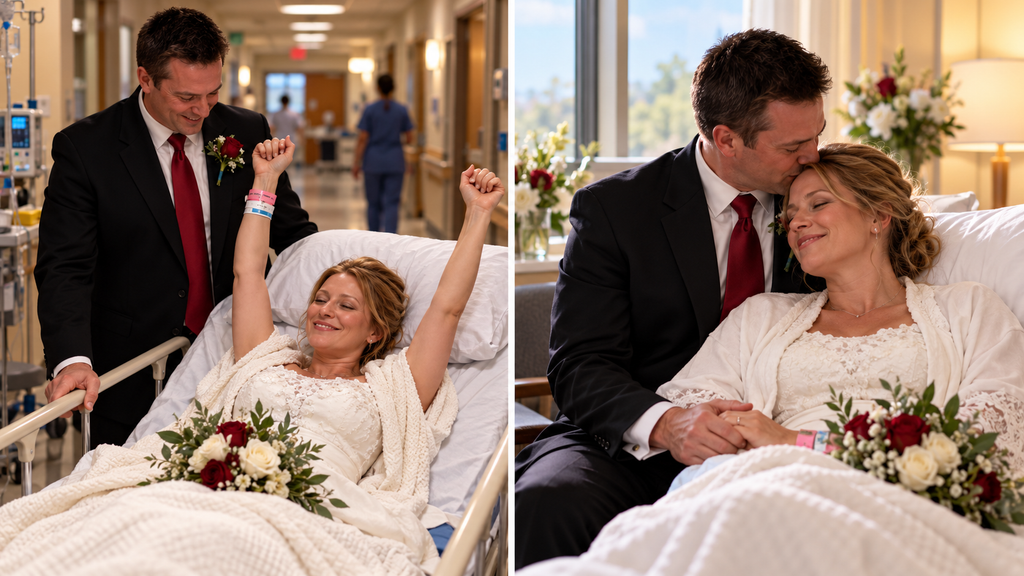
On the top shelf was the white cardboard box from our hospital wedding.
Inside were photographs.
A nurse had taken most of them.
Margaret had hated every picture of herself during treatment.
She said steroids made her face round.
She said her hair looked terrible.
She said hospital gowns were designed by people who hated humanity.
But in those wedding photographs, she looked beautiful.
Not because she looked healthy.
She didn’t.
She looked exhausted.
Fragile.
Her skin was pale, and there were dark circles beneath her eyes.
But she was smiling.
Really smiling.
In one photograph, I was bending over her hospital bed, and she had one hand against my cheek.
In another, we were showing our rings to the camera.
And in the last picture, Margaret was looking at me while I looked toward the nurse taking the photo.
I had never noticed her expression before.
She wasn’t smiling.
She was studying me.
Almost as if she were memorizing my face.
That picture destroyed me.
I sat on the bedroom floor with my back against the closet and cried until dawn.
At 9:42 the next morning, I pulled into the parking lot of Whitmore, Kane & Ellis.
The building was one of those old converted houses lawyers seem to love.
Red brick.
White columns.
A brass plaque beside the door.
I carried the wedding certificate in a manila folder.
My hands were shaking.
Inside, a receptionist stood immediately.
“Mr. Foster?”
“Yes.”
“Mr. Whitmore is expecting you.”
The lawyer from the phone call appeared at the end of the hallway.
He was probably in his late sixties.
Silver hair.
Wire-frame glasses.
Navy suit.
He walked toward me and extended his hand.
“Daniel.”
“Mr. Whitmore.”
“Please. Call me Henry.”
His handshake was firm but warm.
He looked at me for a second longer than normal.
Then his eyes softened.
“I’m very sorry about Margaret.”
“Thank you.”
“She was remarkable.”
That surprised me.
“You knew her well?”
“Well enough.”
He gestured down the hallway.
“Come with me.”
His office smelled like old books and coffee.
There were framed diplomas on one wall and a photograph of a golden retriever on another.
Henry closed the door.
Then I noticed we weren’t alone.
A woman sat near the window.
She looked about sixty.
Elegant.
Gray-blond hair.
Dark green coat.
Pearl earrings.
When she saw me, she stood.
Her face changed.
Not dramatically.
Just enough.
She looked like someone seeing a ghost.
“Daniel,” Henry said, “this is Margaret’s aunt, Evelyn Mercer.”
I frowned.
“Her aunt?”
The woman swallowed.
“Yes.”
Margaret had mentioned an Aunt Evelyn once.
Maybe twice.
Never kindly.
I remembered something about a Christmas argument years earlier.
A family that cared more about appearances than people.
Evelyn extended her hand.
I did not take it.
“I don’t think Margaret wanted me to know you.”
Her hand lowered.
“That’s probably true.”
Henry stepped between us gently.
“Sit, please.”
I took the chair opposite his desk.
Evelyn sat near the window again.
Henry opened a thick folder.
“First, the marriage certificate.”
I slid it across the desk.
He examined it carefully.
Then nodded.
“Everything is valid.”
I felt irritation flare.
“Was someone saying it wasn’t?”
Evelyn looked away.
Henry removed his glasses.
“That is one of the reasons we’re meeting.”
My eyes went to her.
“What did you do?”
“Daniel—”
“What did you do?”
Her jaw tightened.
“I questioned whether Margaret was medically competent when she married you.”
The room went silent.
I stared at her.
“You questioned our marriage?”
“I had concerns.”
“She proposed to me.”
“I know.”
“You weren’t even there.”
“I know that too.”
“Then what exactly were you concerned about?”
Evelyn’s face hardened defensively.
“Margaret was on powerful medication. She was dying. She made major estate changes days before an extremely dangerous surgery.”
I stood.
Henry raised a hand.
“Daniel.”
“No.”
My voice shook.
“She spent years refusing to marry me because she was afraid I would inherit her debt. Then the one time she changes her mind, her family tries to call her confused?”
“I didn’t say confused.”
“You challenged whether she knew what she was doing.”
Evelyn stood too.
“I loved my niece.”
“Then where were you?”
That landed.
Her lips parted.
Nothing came out.
I continued.
“Where were you when she spent six hours vomiting after infusions? Where were you when she couldn’t walk from the bedroom to the bathroom without sitting down halfway? Where were you when insurance denied medication her doctor said might keep her alive?”
Her eyes filled.
But I was too angry to care.
“She had a four-million-dollar trust and still worried about medical bills. Why?”
Evelyn looked at Henry.
Henry said nothing.
So she answered.
“Because she wouldn’t touch the money.”
“What?”
“The trust came from my mother. Margaret’s grandmother.”
“I know that much.”
“She considered it poisoned.”
I laughed once.
Not because anything was funny.
“What does that mean?”
Evelyn sat slowly.
“My family has money, Daniel. Old money. Real-estate money. Manufacturing. Investments. The sort of money that makes people behave badly while convincing themselves they’re behaving responsibly.”
I didn’t respond.
She continued.
“When Margaret’s parents died, my mother became involved in raising her.”
Margaret had told me about the accident.
A drunk driver.
She had been seventeen.
But she never talked much about what happened afterward.
“My mother believed grief could be cured with structure,” Evelyn said. “Rules. Schools. Schedules. Expectations.”
“That sounds pleasant.”
“It wasn’t.”
For the first time, Evelyn almost smiled.
“No. It wasn’t.”
Henry slid a document toward me.
“Margaret gained full control of the trust at twenty-five. Approximately eighteen months before meeting you.”
I stared at the page.
The numbers were worse when written down.
$4,263,817.
“And she never used it?”
“Not personally,” Henry said.
“What does that mean?”
“She used investment income anonymously.”
“For what?”
Henry looked toward Evelyn.
Then back at me.
“Patient assistance.”
I felt my anger pause.
“What?”
He opened another folder.
“Margaret established a private charitable fund two years ago.”
I blinked.
“She did what?”
“It paid medical expenses for patients whose insurance denied critical treatment.”
I didn’t speak.
Couldn’t.
Henry pushed several pages toward me.
Names had been removed.
There were dates.
Hospital systems.
Amounts.
Eight hundred dollars.
Six thousand.
Twenty-seven thousand.
Fourteen thousand.
Thirty-eight thousand.
A hundred and seven payments.
I looked up.
“She did this?”
Henry nodded.
“She insisted on anonymity.”
“Why didn’t she tell me?”
“She believed you would try to stop her.”
“I wouldn’t have.”
Evelyn looked at me.
“You would have told her to save some for herself.”
I opened my mouth.
Then stopped.
Because she was right.
Henry leaned back.
“Margaret knew that.”
I stared at the papers again.
All those nights at our kitchen table.
All those bills.
All those moments she counted coins and complained about hospital parking.
And somewhere, quietly, she was paying strangers’ medical bills.
“That still doesn’t explain the marriage.”
“No,” Henry said. “It doesn’t.”
He opened the final folder.
“This does.”
He removed an envelope.
My name was written across the front.
Not typed.
Written.
Margaret’s handwriting.
DANIEL.
My fingers immediately went numb.
Henry placed it in front of me.
“She gave this to me six weeks before the surgery.”
“Six weeks?”
“Yes.”
“She knew she was going to marry me?”
“No.”
I looked up.
Henry’s expression was strange.
“She was still refusing.”
“Then why write this?”
“Because she knew she might change her mind.”
I touched the envelope.
There was a small grease stain near the corner.
Margaret used to eat crackers while writing.
I imagined her licking salt from her thumb, rolling her eyes at whatever sentimental thing she was putting on paper.
For a moment, the room disappeared.
It was just the envelope.
Her handwriting.
Her hand.
Something she had touched.
“Read it,” Evelyn whispered.
I looked at her.
She was crying now.
Quietly.
I broke the seal.
Inside were four pages.
The first line nearly stopped my heart.
Danny,
If you’re reading this, then I finally got you to put on a decent shirt and marry me.
I laughed.
One terrible, broken sound.
Then I covered my mouth.
Henry lowered his eyes.
I kept reading.
You’re probably confused.
Actually, knowing you, you’re probably angry.
You hate surprises unless they involve pizza.
So I’m sorry.
Sort of.
The truth is, I knew about the trust from the beginning.
Obviously.
What I did not know was what to do with it.
For years, the money felt like something attached to the worst part of my life.
Grandmother controlled everything with money.
School.
Friends.
Clothes.
Where I lived.
Where I traveled.
Even grief.
After Mom and Dad died, every decision became something I had to earn by behaving the way she wanted.
When she died and left me the trust, everyone expected me to be grateful.
I wasn’t.
I was angry.
So I ignored it.
Then I got sick.
And something strange happened.
Money stopped looking like money.
It started looking like time.
A treatment.
A prescription.
A hotel room near a hospital.
A mother who could take a week off work to stay beside her child.
A man who wouldn’t have to choose between insulin and rent.
That’s why I started the fund.
But that isn’t why I married you.
My vision blurred.
I wiped my eyes.
I continued.
I married you because I discovered something Henry didn’t know until I forced him to read the trust documents line by line.
Grandmother attached a clause.
If I died without a legal spouse or child, control of the trust would pass to the Mercer Family Foundation.
That foundation is controlled by Aunt Evelyn and Uncle Richard.
Before you decide you hate Evelyn, keep reading.
Richard is the problem.
Evelyn is complicated.
There’s a difference.
I glanced toward her.
She looked down.
I returned to the letter.
Uncle Richard intends to shut down the patient fund.
I know because I heard him say it.
He called it “sentimental leakage.”
He wants the trust invested in Mercer developments.
The same developments that have made the family richer every year.
If I died unmarried, he would eventually control almost everything.
If I married you, you became my statutory heir, and I could appoint you successor trustee without needing his consent.
There it was.
The reason.
Not romance.
Not exactly.
War.
Margaret had married me to fight a war after she was dead.
I looked at Henry.
“Richard knows?”
“He does now.”
“When?”
“Three days after Margaret died.”
“And?”
“He filed an objection.”
Evelyn shut her eyes.
I felt cold.
“What kind of objection?”
“He intends to challenge the will, the marriage, and your appointment as trustee.”
I slowly lowered the letter.
“He’s trying to take it.”
Henry nodded.
“Yes.”
“How much?”
“All of it.”
I laughed again, but this time there was no grief in it.
Only disbelief.
“Margaret has been dead three weeks.”
“I know.”
“And he’s already in court?”
“Yes.”
I looked at Evelyn.
“And you?”
She met my eyes.
“I originally supported the competency review.”
“Why?”
“Because I believed Richard when he told me the patient fund was draining the trust.”
“How much had Margaret given away?”
Henry answered.
“About four hundred eighty thousand dollars over two years.”
“And the trust is worth four point two million?”
“Currently closer to four point six, actually. Investment growth.”
I looked at Evelyn.
“So it wasn’t draining anything.”
“No.”
“Did you know that?”
“No.”
“Did you bother checking before questioning my dead wife’s mind?”
Her face collapsed.
“No.”
That answer mattered more than excuses would have.
For a long moment, no one spoke.
Then Henry pointed toward the letter.
“There’s more.”
I looked down.
Margaret’s handwriting continued.
Danny, I know what you’re thinking.
You’re thinking, “You married me for paperwork?”
No.
Dummy.
I wanted to marry you from the first year.
I wanted the stupid cake.
I wanted to watch you pretend you weren’t crying when I walked toward you.
I wanted to argue about napkin colors and dance badly and hear your mother complain about the food.
I wanted all of it.
I said no because I was scared.
Not of leaving you debt.
Not really.
That was part of it.
But mostly I was scared of giving myself something beautiful when I knew I might lose it.
I thought if I never became your wife, then somehow dying wouldn’t hurt as much.
That was incredibly stupid.
Loving you already gave me everything to lose.
The title wouldn’t have changed that.
By the time I understood, I was running out of time.
So yes, the trust gave me a practical reason.
It gave me an excuse to finally stop being afraid.
I married you because I loved you.
I chose you as trustee because I trust you.
Those are not the same decision.
Please never confuse them.
I stopped reading.
I pressed the letter against my mouth.
The office became very small.
I could smell her shampoo.
Impossible.
But I could.
Some memory had reached into my chest and pulled it forward.
Coconut.
Cheap pharmacy coconut shampoo.
“What happens now?” I asked.
Henry waited until my voice steadied.
“There is a hearing in eleven days.”
“Eleven?”
“Yes.”
“What does Richard want?”
“To invalidate Margaret’s final amendment.”
“And if he wins?”
“The trust reverts to the Mercer Family Foundation.”
“And the patient fund?”
“Almost certainly closed.”
I looked down at Margaret’s letter.
There were two pages left.
I turned the page.
One more thing.
I can’t make you continue the fund.
I don’t want to.
If keeping it becomes too painful, stop.
If you want to walk away from the Mercers and every dollar connected to them, do it.
I will not haunt you.
Much.
But if you choose to continue, there is something I want you to understand.
Don’t turn me into a saint.
I wasn’t one.
I was stubborn.
I lied about how much pain I was in.
I stole your fries after ordering salad.
I once blamed you for losing the car keys when they were in my coat pocket.
I avoided my family instead of confronting them.
And I waited too long to marry you.
Tell the truth about me.
Then help people anyway.
That’s enough.
I smiled through tears.
The final paragraph was shorter.
And Danny?
When this is over, go live.
That is not a suggestion.
Love someone again someday if you can.
Buy a house with a porch.
Get a dog.
Travel somewhere that doesn’t have a hospital within walking distance.
Do not make my grave the address where you spend the rest of your life.
You gave me years I wasn’t supposed to have.
Do something beautiful with yours.
Your wife,
Margaret.
P.S. Margarine is still not funny.
I sat there staring at the signature.
Your wife.
We had been married six days.
Six days.
And somehow those two words carried the weight of a lifetime.
Evelyn quietly left the office.
I barely noticed.
Henry gave me time.
Eventually, I folded the letter along its original creases.
“What do I need to do?”
His eyebrows lifted.
“You don’t have to decide today.”
“I already decided.”
“Daniel.”
“She wanted the fund protected.”
“Yes.”
“Then we protect it.”
Henry studied me.
“Richard has significant resources.”
“So does Margaret.”
A faint smile appeared.
“Yes.”
“And apparently,” I added, “so do I.”
That smile grew.
“Yes, you do.”
For the first time since Margaret died, I felt something besides grief.
Purpose.
It terrified me.
But it was there.
The next eleven days were ugly.
Richard Mercer turned out to be exactly the sort of man Margaret had described.
He was sixty-four, tall, silver-haired, and so polished he looked manufactured.
The first time I saw him was in Henry’s conference room.
He entered with two attorneys.
Not one.
Two.
He looked at me the way wealthy men sometimes look at waiters they think have interrupted them.
“So you’re Daniel.”
I stood.
“You’re Richard.”
His eyes moved over my suit.
I had borrowed it from my older brother.
Richard noticed.
Of course he did.
He extended a hand.
I shook it.
“Margaret spoke highly of you,” he said.
“That would probably have meant more if you had spoken to her yourself.”
His smile disappeared.
Henry nearly coughed into his hand.
Richard sat.
The meeting was supposed to be about settlement.
Within five minutes, I understood settlement meant surrender.
One of Richard’s attorneys pushed a folder across the table.
“Mr. Mercer is prepared to offer you three hundred thousand dollars.”
I looked at the number.
Then at Richard.
“For what?”
“In exchange for withdrawing as successor trustee and agreeing not to oppose the trust’s return to the foundation.”
I leaned back.
“You’re offering me Margaret’s money to let you take Margaret’s money.”
Richard sighed.
“This does not need to become emotional.”
“My wife died twenty-six days ago.”
“I understand.”
“No, you don’t.”
His jaw tightened.
“Margaret’s illness affected her judgment.”
“There it is.”
“I loved my niece.”
“You barely saw her.”
“That was her choice.”
“Was it?”
Richard’s eyes hardened.
Henry put a hand on my forearm beneath the table.
A warning.
I ignored it.
“Margaret wrote that you called helping sick people ‘sentimental leakage.’”
Richard stopped breathing for half a second.
Small.
But I saw it.
His attorney interrupted.
“We’re not here to discuss alleged private conversations.”
I looked at Richard.
“So you said it.”
He folded his hands.
“I don’t recall.”
“That means yes.”
Richard leaned toward me.
“You have no idea what you’ve stepped into.”
“Then explain it.”
“The Mercer assets have supported hundreds of employees, families, charitable organizations, scholarships—”
“And apparently one dying woman wasn’t allowed to decide what happened to her own money.”
“That trust was never intended to become a personal charity.”
“It was hers.”
“It came from our family.”
“It came to Margaret.”
His nostrils flared.
“You knew her three years.”
“Best three years of my life.”
“You think that makes you family?”
I almost smiled.
“She thought so.”
The meeting ended six minutes later.
I declined the offer.
Richard increased it to five hundred thousand.
I declined again.
At the door, he caught my arm.
Not hard.
Just enough to make the gesture feel deliberate.
“You should think carefully.”
I looked down at his hand.
Then up at him.
“Take your hand off me.”
He did.
“You’re grieving,” he said quietly. “You’re not thinking clearly.”
I stepped closer.
“Funny. That’s exactly what you said about Margaret.”
His face changed.
For the first time, I saw anger underneath the polish.
“You are making a mistake.”
“Maybe.”
I smiled.
“She liked when I did that.”
That evening, someone broke into my apartment.
Nothing obvious was stolen.
That was the frightening part.
The television remained.
Laptop untouched.
Margaret’s jewelry box still sat in the bedroom drawer.
But the closet had been opened.
The white wedding box was on the floor.
Photographs scattered.
And Margaret’s letter was gone.
I stood in the bedroom doorway while two police officers moved through the apartment.
One of them asked if I had enemies.
I almost laughed.
“Apparently.”
Henry arrived twenty minutes later.
When I told him about the letter, his face changed.
“Did Margaret give you any other documents?”
“No.”
“Anything from the wedding? Hospital records? Notes?”
“Nothing that matters.”
He looked at me sharply.
“What does that mean?”
“There’s a video.”
“What video?”
“The wedding.”
Henry became still.
“Who has it?”
“My friend Marcus recorded most of the ceremony.”
“Original file?”
“I think so.”
“Call him.”
I did.
Marcus answered on the second ring.
“Hey, man.”
“Do you still have the hospital wedding video?”
Silence.
Then, “Yeah.”
“The original?”
“Yeah. Why?”
“Don’t send it to anyone.”
“What’s going on?”
“Back it up. Right now.”
Marcus laughed nervously.
“Okay.”
“I’m serious.”
“I know. I’m doing it.”
Henry stood beside me.
“Tell him cloud storage, external drive, and one copy outside his home.”
I repeated it.
Marcus stopped joking.
“Daniel.”
“Yeah?”
“Are you in trouble?”
I looked around our bedroom.
Margaret’s photographs were on the floor.
“I don’t know.”
The police found no usable fingerprints.
No camera footage.
Our building’s hallway camera had been broken for months.
The next morning, Evelyn called me.
“I need to see you.”
“I’m busy.”
“It’s about Richard.”
That got my attention.
We met at a coffee shop two blocks from Henry’s office.
Evelyn looked terrible.
No makeup.
Hair pulled back.
Her hands shook when she lifted her cup.
“I think Richard broke into your apartment.”
I stared at her.
“Why?”
“Because he called me last night asking about Margaret’s letter.”
My stomach dropped.
“How did he know about it?”
“I told him.”
I stood.
She grabbed my sleeve.
“Please.”
“You told him?”
“I didn’t know what was in it.”
“You knew enough.”
“I know.”
I pulled my arm free.
She started crying.
Not dramatically.
Quietly.
I hated that it made me hesitate.
“I spent my entire life letting my brother be the loudest person in the room,” she said. “When our father died, Richard ran the company. When our mother got sick, Richard handled the foundation. He always knew what was responsible, what was practical, what was best.”
“And Margaret?”
“I told myself she was ungrateful.”
I sat again.
Evelyn wiped her face.
“When she got sick, I reached out. She wouldn’t answer.”
“Can you blame her?”
“No.”
That surprised me.
She opened her purse and removed a small flash drive.
“What is that?”
“Something Richard doesn’t know I have.”
I didn’t touch it.
“What?”
“Foundation meeting recordings.”
I stared at her.
“You recorded him?”
“No. The meetings were automatically recorded for minutes.”
“And?”
“There’s a meeting from six months ago. Margaret attended by video without Richard realizing she had joined.”
My heart kicked.
“What did he say?”
Evelyn slid the drive toward me.
“Listen.”
That afternoon, Henry played the recording in his office.
Richard’s voice filled the room.
Smooth.
Certain.
Annoyed.
“Margaret’s health is declining faster than expected.”
Another man asked, “What happens to the trust?”
Richard answered.
“On her death, it returns to the family structure.”
“What about the medical assistance program?”
A short laugh.
“That ends.”
Evelyn’s recorded voice said, “She cares about that program.”
“And she won’t be here to care.”
My skin crawled.
Then Richard continued.
“We’ve lost enough to sentimental leakage already. Once control returns, we fold the remainder into the real-estate portfolio.”
A different voice asked, “Can Margaret change the beneficiary structure?”
Richard paused.
“Not effectively.”
“How do you know?”
“Because she has no spouse, no children, and no intention of marrying.”
There was a faint electronic sound.
Someone had joined the virtual meeting.
Nobody noticed.
Then, twenty-three seconds later, another sound.
Someone left.
Henry stopped the recording.
“That was Margaret.”
Evelyn nodded.
I leaned back.
“She heard him.”
“Yes.”
“That’s why she proposed.”
“Probably.”
I thought of that night.
Margaret in her hospital bed.
Her fingers around mine.
I might not make it out.
I want to die as your wife.
She had told me the truth.
Just not all of it.
She wanted to die as my wife.
And she wanted Richard to lose.
Both could be true.
That was Margaret.
She never did anything for only one reason.
“Can we use this?”
Henry nodded.
“Absolutely.”
The hearing began on a Thursday.
Margaret had been dead thirty-four days.
I remember that because I counted every morning.
The courtroom was smaller than television had taught me to expect.
No dramatic gallery.
No jury.
Just wood benches, a judge, lawyers, paper, and people pretending the truth could be organized into folders.
Richard sat across the aisle.
Evelyn sat behind me.
She had officially withdrawn her challenge two days earlier.
Richard had not spoken to her since.
His attorneys argued that Margaret’s final estate amendments were the product of medication, fear, and manipulation.
Manipulation.
That was me.
They painted me as a financially struggling boyfriend who had suddenly benefited from a deathbed marriage.
One attorney actually used the phrase “opportunistic intimacy.”
I almost stood up.
Henry stopped me.
Then they introduced photographs.
My apartment.
My old car.
My income.
Credit-card debt from medical expenses.
Richard’s attorney turned to the judge.
“Mr. Foster had substantial financial incentive.”
Henry stood.
“Your Honor, Mr. Foster proposed marriage repeatedly for two years before knowing the trust existed.”
“According to him.”
Henry smiled.
“According to thirty-seven text messages, six emails, three witnesses, and one highly embarrassing video involving a restaurant mariachi band.”
The judge looked at me.
I looked down.
Margaret would have loved that.
The courtroom heard testimony from her doctors.
That changed everything.
Dr. Patel had treated Margaret for nearly two years.
Richard’s lawyer asked, “Was Margaret taking opioid pain medication?”
“Yes.”
“Sedatives?”
“At times.”
“Medication that can impair judgment?”
“At certain doses, yes.”
“So it is possible she lacked full capacity.”
Dr. Patel stared at him.
“It is possible you lack full capacity right now.”
The judge looked over her glasses.
“Doctor.”
“Apologies, Your Honor.”
I almost laughed.
The attorney stiffened.
“Did you personally assess Margaret’s mental status during the week of the wedding?”
“Every day.”
“And?”
“She was fully oriented.”
“What does that mean?”
“She knew who she was, where she was, what date it was, what procedure she was facing, and the legal implications of her decisions.”
“Did she discuss marriage with you?”
“Yes.”
“What did she say?”
Dr. Patel glanced toward me.
“She said, ‘I finally stopped being an idiot.’”
A few people laughed.
Even the judge smiled.
Richard did not.
Then Marcus testified.
He brought the wedding video.
The courtroom monitor flickered.
And suddenly Margaret was alive again.
There she was.
Hospital bed.
Yellow flowers beside the window.
Her mother’s old lace scarf wrapped over her head.
Me beside her.
I had forgotten how nervous I looked.
The officiant asked Margaret whether she entered the marriage freely.
She rolled her eyes.
“If he asks me one more time, I’m changing my mind.”
People laughed on the recording.
Then she squeezed my hand.
“Yes. Freely.”
“Do you understand the legal nature of marriage?”
“Unfortunately.”
More laughter.
The officiant smiled.
“And do you take Daniel—”
“Yes.”
“Let me finish.”
“I’m on a schedule.”
The courtroom went quiet.
Because everyone knew what schedule she meant.
The officiant’s smile faded.
Margaret looked at me.
Really looked.
Then she said words I had forgotten.
“Sorry. Keep going.”
The video continued.
When we reached the vows, Margaret had insisted on speaking first.
“Daniel, I don’t know how much time I have.”
My chest collapsed.
I had heard it once.
In the hospital.
But grief had erased parts.
Now every word returned.
“I wish I could promise forty years. I wish I could promise ten. I can’t even promise next month. So I’m only promising what I actually have.”
Her voice shook.
“Whatever time exists between this breath and my last one belongs beside you.”
I covered my face.
No one in court moved.
On-screen, Margaret smiled.
“And if there’s anything after that, I’ll probably annoy you there too.”
My recorded self laughed and cried at the same time.
Then she whispered.
“I choose you. Completely. While I still can.”
The video ended.
Silence.
Richard’s attorney did not ask Marcus another question.
The next morning, Richard testified.
That was the mistake that destroyed him.
At first, he was excellent.
Calm.
Reasonable.
He spoke about family stewardship.
Long-term financial responsibility.
Margaret’s decline.
His concern for her.
Then Henry stood for cross-examination.
“Mr. Mercer, how many times did you visit Margaret during the final year of her life?”
“I don’t remember.”
“Approximately.”
“Several.”
Henry picked up a page.
“Hospital records show two visits.”
“That sounds incomplete.”
“How many times did you call her?”
“I don’t keep records of family calls.”
“We do.”
Richard’s face tightened.
“Six calls. Total duration: twenty-nine minutes.”
No response.
Henry continued.
“You described her medical charity as sentimental leakage.”
“Taken out of context.”
“Explain the context.”
“It was a financial discussion.”
“So sick people receiving assistance were the leakage?”
“No.”
“What was?”
Richard hesitated.
“That was an unfortunate phrase.”
Henry walked toward the monitor.
“Did you tell your board that Margaret’s program would end after her death?”
“I discussed restructuring.”
“Did Margaret authorize restructuring?”
“No.”
“Did she tell you she wanted the program continued?”
“She and I disagreed.”
“Did she tell you she intended to preserve it?”
“Yes.”
“And you intended to end it anyway.”
“I intended to act responsibly.”
Henry paused.
“After Margaret married Daniel, what did you do?”
“Consulted counsel.”
“About challenging her marriage?”
“Yes.”
“Before or after her funeral?”
Richard stopped.
I felt Evelyn move behind me.
Henry repeated the question.
“Before or after her funeral?”
Richard’s attorney objected.
The judge overruled.
Richard swallowed.
“Before.”
My hands curled into fists.
Before her funeral.
While I had been sitting beside Margaret’s coffin.
While her wedding ring was still on her hand.
Richard had already been trying to erase the marriage.
Henry nodded slowly.
“When did you first contact counsel?”
“I don’t remember.”
Henry displayed an email.
“Eleven hours after Margaret died.”
A sound moved through the courtroom.
Not quite a gasp.
Close.
Richard looked at his attorney.
Henry wasn’t finished.
“And what did your email say?”
“I don’t recall the precise wording.”
“I do.”
Henry read.
“‘Confirm whether hospital marriage can be invalidated before Foster gains access to trust documents.’”
Richard looked at me.
For the first time, I saw something besides arrogance.
Fear.
Henry continued.
“You weren’t concerned about Margaret’s mental capacity, were you?”
“I was.”
“Eleven hours after she died?”
“Yes.”
“You were concerned about control.”
“No.”
“Money.”
“No.”
“The Mercer portfolio.”
“No.”
Henry turned toward the judge.
“Then perhaps Mr. Mercer can explain why, three months before Margaret’s death, his development company prepared a preliminary financing document listing Margaret’s trust assets as anticipated collateral.”
Richard’s attorney shot to his feet.
“Objection!”
Henry held up the document.
The judge leaned forward.
“What document?”
Evelyn had found that one too.
Buried in foundation records.
Richard had been planning to borrow against assets he did not yet control.
The courtroom exploded into legal argument.
I barely understood half of it.
But I understood Richard’s face.
He was finished.
Not legally.
Not yet.
But emotionally.
His certainty disappeared.
The judge called recess.
In the hallway, Richard came toward me.
His attorneys tried to stop him.
He ignored them.
“You think you won?”
I stood.
“I think Margaret did.”
His eyes burned.
“She manipulated the trust.”
“No. She read it.”
“She was vindictive.”
I smiled.
“She could be.”
“She did this to punish me.”
“No.”
I stepped closer.
“She did it because you told everyone she had no intention of marrying.”
Richard’s expression flickered.
I continued.
“She heard the meeting.”
He froze.
Evelyn stepped into the hallway behind me.
“She heard everything.”
Richard looked at his sister.
His face drained.
“You gave them the recording.”
“Yes.”
“You stupid—”
“Careful.”
My voice came out low.
Richard looked at me.
I had never been a violent man.
I still wasn’t.
But something in my face made him stop.
Evelyn moved beside me.
“For thirty years,” she told him, “I let you decide what was best.”
Richard stared at her.
“You have no idea what you’re doing.”
“For the first time, I think I do.”
The ruling came five days later.
I was at home when Henry called.
I had finally forced myself to remove the hospital wristband Margaret had worn during our wedding.
It was sitting on the kitchen table.
My phone rang.
“Daniel.”
I stood.
“Well?”
Henry laughed.
That was all I needed.
“We won.”
My knees gave out.
I sat on the floor.
“Everything?”
“Everything.”
“The marriage?”
“Valid.”
“The will?”
“Valid.”
“Trustee?”
“You.”
I covered my eyes.
“And Richard?”
“The judge referred portions of the evidence for further review relating to possible fiduciary misconduct.”
I laughed.
Then cried.
Then laughed again.
Henry let me.
After a minute, he said, “Margaret’s fund is safe.”
That was the sentence that mattered.
Not the money.
Not Richard.
Not even winning.
Margaret’s fund is safe.
I looked toward her chair.
The one she always sat in by the window.
For half a second, I expected to see her there.
Blanket across her knees.
Tea cooling beside her.
Smirking.
“Told you,” I whispered.
The apartment answered with silence.
The months after the hearing were harder than the hearing itself.
Purpose is useful.
But grief is patient.
When the lawyers stopped calling and the documents were signed, I had to wake up again in an apartment without Margaret.
There was no enemy to fight.
No deadline.
Just Tuesday.
Then Wednesday.
Then Thursday.
Her thirty-first birthday arrived.
I bought a cupcake.
I hated myself for buying it.
Then I hated myself for almost throwing it away.
So I drove to the cemetery.
It was raining.
Of course it was.
Margaret hated rain.
“Terrible planning,” I told her grave.
I sat on wet grass.
Her headstone looked too clean.
Too new.
MARGARET ELAINE FOSTER.
Beloved Daughter.
Beloved Friend.
Beloved Wife.
That last word broke me every time.
I placed the cupcake beside the stone.
“Chocolate. Your favorite.”
I waited.
Nothing.
“Also, your uncle might be investigated for fraud.”
Rain tapped my jacket.
“You’re welcome.”
I smiled.
Then the smile vanished.
“I don’t know what I’m doing.”
The cemetery was empty.
“You left me four million dollars and instructions to go live.”
My throat tightened.
“That was rude.”
I touched her name.
“I was good at taking care of you.”
The rain grew heavier.
“I’m terrible at taking care of me.”
That was the first time I said it aloud.
Something changed after that.
Not dramatically.
No music.
No revelation.
Just permission.
Permission to admit I was lost.
I began therapy.
I hated it.
Margaret would have loved that.
The therapist was a woman named Dr. Lucas who refused to let me make jokes whenever conversation became uncomfortable.
I called this cruel.
She called it therapy.
Three months after Margaret died, I resigned from my job.
Not because I inherited money.
Because the patient fund needed someone full-time.
Henry helped restructure it into an independent nonprofit.
Evelyn joined the board.
So did Dr. Patel.
Marcus handled communications.
I refused to name it after Margaret.
She had specifically said not to turn her into a saint.
Instead, we called it the Open Door Fund.
Our first expanded grant went to a forty-two-year-old school bus driver named Teresa whose insurance had denied an experimental autoimmune treatment.
When Henry told me the diagnosis, I had to leave the room.
Too close.
I almost rejected the application because of that.
Then I imagined Margaret screaming at me.
So we paid it.
Teresa lived.
Not because of us alone.
Medicine saved her.
Doctors saved her.
Luck saved her.
But money opened the door.
That was the point.
A year passed.
Then two.
The trust grew instead of shrinking.
Turns out Margaret had known what she was doing.
We used investment earnings.
Donations followed.
A local paper wrote about the fund.
Then a national one.
I hated interviews.
Evelyn was excellent at them.
One afternoon after an event, she handed me a photograph.
It showed Margaret at thirteen.
Wild hair.
Braces.
Standing beside a horse.
I laughed.
“She rode horses?”
“Badly.”
“She never told me.”
“She broke her wrist that afternoon.”
“That sounds like her.”
Evelyn smiled.
Then her eyes watered.
“I should have known her better.”
I looked at the photograph.
“Yes.”
She flinched.
I continued.
“But she gave you another chance.”
Evelyn looked at me.
“The recording.”
“What?”
“She knew you were in that meeting. She knew you heard Richard. She could have cut you out completely.”
Evelyn stared down.
“She didn’t.”
“No.”
“Why?”
I thought about Margaret.
Complicated.
Stubborn.
Soft-hearted when she pretended not to be.
“Because she probably hoped you’d eventually do the right thing.”
Evelyn nodded.
“I hope I am.”
“Keep doing it.”
Four years after Margaret died, I bought a house.
Not because I needed one.
Because of the letter.
Buy a house with a porch.
It was small.
Two bedrooms.
Blue shutters.
A maple tree in front.
And, most importantly, a ridiculous wraparound porch.
The day I signed the papers, Henry came with me.
He stood on the porch.
“Well?”
I looked at the house.
“She would hate the shutters.”
“Then change them.”
“No.”
“Why?”
“Because I can hear her complaining.”
Henry smiled.
“Good reason.”
I got the dog six months later.
A mutt.
Brown.
Too large for my furniture.
He had one white paw and ears that pointed in different directions.
The shelter had named him Captain.
I renamed him Ramen.
Because grief gives you strange humor.
Ramen destroyed two pillows, one shoe, and a copy of Henry’s trust handbook.
Margaret would have approved of the last one.
Dating took longer.
Much longer.
For years, every woman felt like betrayal.
Then one evening after a fundraiser, I met Anna.
She was not Margaret.
That mattered.
Anna was quiet where Margaret had been loud.
She liked hiking.
Margaret considered walking uphill a design flaw.
Anna drank black coffee.
Margaret believed coffee existed primarily as a delivery system for sugar.
Our first date was awkward.
I talked too much about the nonprofit.
She spilled soup.
I went home certain neither of us would call.
She texted the next morning.
YOU ARE LESS WEIRD THAN I EXPECTED.
I stared at the message.
Then laughed.
We became friends first.
That helped.
Six months later, sitting on the porch, I told her everything.
The hospital.
The wedding.
The trust.
The hearing.
The letter.
Margaret.
All of it.
When I finished, Anna was quiet.
“That’s a lot.”
“Yeah.”
“Do you still love her?”
I looked at the yard.
Ramen was digging a hole he had been told not to dig.
“Yes.”
Anna nodded.
I waited for her to leave.
She didn’t.
Instead she said, “I don’t think love has to become smaller just because life gets bigger.”
I looked at her.
That sentence terrified me.
Because it sounded true.
Two years later, Anna and I married.
There was a ballroom.
There were flowers.
There was a first dance.
My mother complained about the food.
Margaret had predicted that part.
Before the ceremony, I went alone to the cemetery.
I sat beside Margaret’s grave.
“I’m doing the thing.”
Wind moved through the trees.
“She’s good.”
I smiled.
“You’d like her.”
Then I reconsidered.
“No. Actually, you’d probably be suspicious of her for six months, then become best friends without telling me.”
I placed a small white flower against the stone.
“I was worried this meant leaving you.”
My voice broke.
“I finally understand it doesn’t.”
I touched the word Wife.
“You were right.”
Then I laughed.
“I hate when that happens.”
Years continued.
The fund helped more people.
A hundred became a thousand.
A thousand became several thousand.
We opened partnerships in three states.
Evelyn eventually became board chair.
Dr. Patel retired and immediately became more involved than before retirement.
Henry died at seventy-eight.
That loss hurt differently.
He had become family.
At his funeral, his son handed me an envelope.
“Dad wanted you to have this.”
Inside was a photocopy of the first page of Margaret’s will.
Across the bottom, Henry had written:
SHE KNEW EXACTLY WHAT SHE WAS DOING.
I framed it.
Anna thought that was weird.
She was correct.
Ten years after Margaret died, I was invited to speak at a hospital fundraiser.
Same hospital.
I almost declined.
Then I saw the ballroom location.
Not the hospital itself.
Safe.
Or so I thought.
Halfway through dinner, a young woman approached my table.
She looked nervous.
“Mr. Foster?”
“Yes?”
“My name is Lily.”
She was maybe twenty-four.
Dark hair.
Blue dress.
“My mother received help from the Open Door Fund.”
I smiled.
“I’m glad.”
“She told me I should meet you.”
“Is she here?”
The young woman’s face changed.
“No. She died last year.”
“I’m sorry.”
“Thank you.”
She sat when I offered the chair.
“My mom got sick when I was fourteen.”
I listened.
“The fund paid for us to stay near the hospital for three months.”
“That’s what it’s for.”
“No.”
Her eyes filled.
“You don’t understand.”
I waited.
“My dad had died. We were about to lose our apartment. My mother wanted to stop treatment because she thought keeping us housed mattered more.”
My throat tightened.
“Someone from your organization paid the hotel and covered rent for four months.”
I looked down.
“I’m glad we could.”
“She lived another nine years.”
Nine years.
Lily smiled through tears.
“She saw me graduate high school.”
I stopped breathing.
“She saw me graduate college.”
My eyes burned.
“She met my fiancé.”
Lily reached across the table.
“So when people say your fund paid medical bills, I think they’re saying it wrong.”
I looked at her.
“What did it pay for?”
She squeezed my hand.
“Time.”
Margaret’s word.
Money stopped looking like money.
It started looking like time.
I excused myself from the ballroom.
I made it to the hallway before I started crying.
Not grief.
Not exactly.
Something larger.
Something gentler.
For years, I thought Margaret’s final gift had been the trust.
Then I thought it was the fund.
Then I thought it was the letter.
I was wrong every time.
Her final gift was meaning.
She had taken the worst thing that happened to us and refused to let it be useless.
She could not defeat her disease.
She could not buy enough time for herself.
So she bought it for someone else.
And then someone else.
And someone else.
Twenty-five years after our hospital wedding, I stood on the porch Margaret had ordered me to buy.
My hair was gray.
Ramen was long gone, though a framed photograph of him still sat beside the front door.
Anna was inside arguing with our grandson about whether cookies counted as dinner.
They did, according to him.
The Open Door Fund had helped 18,411 families.
I knew because the annual report had arrived that morning.
I sat in the porch chair with Margaret’s original letter.
The paper was yellowing.
The folds had nearly worn through.
I had read it hundreds of times.
But that evening, one line felt different.
Do not make my grave the address where you spend the rest of your life.
I looked through the window.
Anna was laughing.
Our daughter was setting plates on the table.
Our grandson pressed his face against the glass and made a ridiculous expression at me.
My life.
Not the life I planned.
Not the life I wanted at twenty-seven.
But life.
Full.
Messy.
Beautiful.
I folded the letter carefully.
“Okay, Margarine.”
The screen door opened behind me.
Anna stepped onto the porch.
“Talking to her again?”
“Yes.”
“What does she say?”
“That your curtains are ugly.”
Anna laughed.
“I knew I wouldn’t like her.”
“You would have.”
“I know.”
She sat beside me.
After a moment, she rested her head against my shoulder.
I looked at the sunset.
When Margaret first proposed, I believed she wanted one last romantic thing before she died.
When Henry read the will, I believed she married me to protect an inheritance.
When Richard challenged us, I believed she married me to win.
It took me years to understand the truth.
Margaret did not marry me because she was dying.
She married me because, at the end of her life, she finally stopped letting death make her decisions.
The trust mattered.
The charity mattered.
Richard mattered.
But underneath all of it was one simple truth.
She had spent years saying no because she was afraid loving me as my wife would make losing me—or making me lose her—hurt more.
Then she realized pain was coming anyway.
So she chose love.
Completely.
While she still could.
And that choice outlived her.
It lived in the patients who received treatment.
In the mothers who got extra months.
In the fathers who came home.
In the children who got one more birthday.
It lived in Evelyn becoming the aunt Margaret had needed too late.
It lived in me learning that grief and happiness could occupy the same heart without canceling each other.
It lived in a house with a porch.
In a second wedding.
In children.
In grandchildren.
In eighteen thousand four hundred eleven families whose names Margaret never knew.
Sometimes people still ask me whether inheriting millions changed my life.
I tell them yes.
But not in the way they expect.
The money was never the inheritance.
Margaret was.
The stubbornness.
The courage.
The ridiculous jokes.
The belief that time mattered more than wealth.
That was what she left me.
And whenever I think about that hospital room, I no longer remember it only as the place where my wife was dying.
I remember the cheap flowers.
The nurses crying.
My borrowed jacket.
Margaret rolling her eyes at the officiant.
The ring slipping over her thin finger.
And the way she looked at me when she said:
“I choose you.”
For years, those words felt like goodbye.
Now I know better.
They were instructions.
Choose love.
Choose people.
Choose the time you have instead of mourning the time you don’t.
Choose to keep living when living feels like betrayal.
Choose to open the door.
And when someone asks why my wife insisted on marrying me during the final week of her life, I no longer say it was because of the will.
I tell them the truth.
The will explained the timing.
But love explained the wedding.
Margaret knew she might die.
She knew her family might fight.
She knew there was money someone would try to control.
She knew there were sick people who would lose help if she did nothing.
So she did the one thing everyone had assumed she would never do.
She took my hand.
She became my wife.
And with six days of marriage, she changed the next forty years of my life.
That was Margaret.
She never needed much time to make herself unforgettable.
She only needed enough time to choose what mattered.
And in the end, she chose me.
Then she taught me how to choose life without her.