
The moment my granddaughter pulled that envelope from her backpack, I felt something change in the courtroom. I didn’t know what was inside it.
I didn’t know why Brandon suddenly looked as though someone had knocked the breath out of him. But I knew my granddaughter. And I knew the expression on her little face.
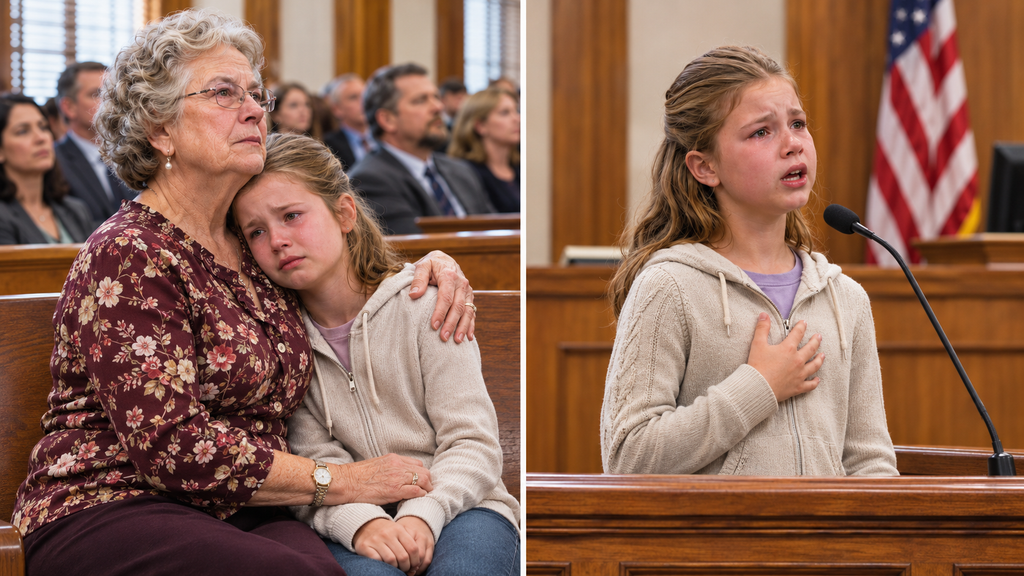
It was the same expression she had worn when she was seven years old and confessed that she had accidentally broken my favorite vase.
Only this time, there was something different in her eyes.
Fear.
Not fear of punishment.
Fear of what might happen when the truth finally came out.
“Sweetheart,” the judge said gently, “what have you brought with you?”
Hazel swallowed.
“It’s something my father doesn’t want anybody to see.”
Brandon immediately rose from his chair.
“Your Honor, this is ridiculous. She’s eleven years old. She doesn’t understand what she’s talking about.”
“Mr. Ward,” the judge replied sharply, “sit down.”
His attorney placed a hand on his arm.
But Brandon wasn’t looking at the judge anymore.
He was staring at the envelope.
And for the first time since he had walked back into our lives, I saw genuine terror on his face.
Hazel carefully removed three folded sheets of paper.
The first was covered in numbers.
The second contained several signatures.
And the third had a photograph attached to it.
She placed them in front of the judge.
“Grandma doesn’t know about this,” she whispered. “I didn’t know how to tell her.”
Judge Miriam Reed adjusted her glasses.
She read the first page.
Then the second.
When she reached the third, she stopped.
Her eyes widened.
She raised one hand to her mouth.
And for several seconds, the courtroom was completely silent.
Finally, she looked directly at Brandon.
“Mr. Ward,” she said slowly, “would you care to explain why your daughter appears to be the beneficiary of a trust worth approximately four million, six hundred thousand dollars?”
I stopped breathing.
Four million?
Six hundred thousand?
I couldn’t even imagine such an amount.
Brandon’s attorney straightened in her seat.
“Your Honor, that information concerns a private family estate. It has no bearing on the custody petition.”
The judge looked at the remaining papers.
“I believe,” she replied, “that we may have a serious disagreement about that.”
Hazel gripped the sides of her backpack.
Then she said something I will remember until the day I die.
“He doesn’t want me because I’m his daughter.”
She turned and looked at Brandon.
“He wants me because I’m worth money.”
A cold silence settled over the room.
And in that moment, I realized that the man who had abandoned my granddaughter eleven years earlier had returned for something far more valuable to him than her love.
He had returned for her inheritance.
But even then, I had no idea how far he had already gone to get it.
Or how much worse the truth was about to become.
The Conversation Hazel Was Never Supposed to Hear
“Tell me everything,” Judge Reed said.
Her voice was gentle now.
Hazel looked toward me.
I wanted to run to her.
To wrap my arms around her shoulders and take her away from that frightening room.
But the judge gave me a small, reassuring nod.
So I stayed where I was.
Hazel took a breath.
“Last Sunday, my dad picked me up for lunch.”
I remembered that afternoon.
Brandon had insisted that Hazel spend time with him before the hearing.
He called it an opportunity for them to bond.
I had been reluctant.
Hazel had begged me not to make her go.
But I was afraid that refusing contact would be used against me in court.
So I had encouraged her to give him a chance.
I had even packed her favorite strawberry cookies in a small container.
“Maybe he’ll surprise you,” I had told her.
Oh, how desperately I wished I could take those words back.
Hazel continued.
“He took me to his house. It’s really big. There’s a swimming pool and a movie room and a staircase that looks like the one in Cinderella.”
A few people smiled faintly.
“But I didn’t like it.”
“Why not?” the judge asked.
“Because he kept telling me everything I would get if I agreed to live there. He never asked me what I wanted.”
My heart tightened.
“He showed me a bedroom with a white carpet and a huge television. He said I could have a new phone and a horse and go shopping whenever I wanted.”
Brandon shifted uncomfortably.
“That’s called providing for my daughter,” he muttered.
The judge gave him a warning glance.
Hazel looked down.
“Then his wife went out to meet somebody, and my dad got a phone call.”
“Where were you?”
“In the room beside his office. He told me to wait there and watch television.”
She hesitated.
“The door was open a little. He was talking really loudly.”
The judge leaned forward.
“What did you hear?”
Hazel’s lower lip trembled.
“He said, ‘I don’t care what the girl wants. I need legal control before the bank comes after everything.’”
The attorney beside Brandon went very still.
Hazel continued.
“He said, ‘Once she’s living here, we’ll get somebody to put me in charge of her money. Four and a half million is more than enough to save the company.’”
Brandon suddenly spoke.
“That is completely out of context!”
“Mr. Ward!”
The judge’s voice echoed through the courtroom.
Hazel flinched.
I rose halfway from my seat.
“Please don’t frighten her,” I said.
The judge nodded.
“Nobody is going to hurt you here, Hazel. Take your time.”
My granddaughter wiped her cheek with the back of her hand.
“Then my dad said something about Grandma.”
I felt a strange pressure in my chest.
“He said she was old and poor and wouldn’t be difficult to get rid of.”
My hands went numb.
“He said the lawyer had someone who could make it look like Grandma couldn’t remember things properly anymore.”
I stared at Brandon.
The man I had once welcomed into my kitchen.
The man whose child my daughter had carried.
The man who had walked out of our home with a suitcase while I held his crying baby.
Eleven years later, he had not returned to thank me.
He had returned to destroy me.
Hazel continued speaking.
“When he finished talking, he went outside. The printer in his office had papers in it. I saw my name on them.”
She pointed to the envelope.
“I know I shouldn’t take things that don’t belong to me. But I saw Grandma’s name too.”
The judge glanced down at the pages.
“And these are the papers you found?”
Hazel nodded.
“One says how much money I have. One says my dad should be in charge of it.”
She paused.
“And the other one says Grandma agreed that he could take me.”
My stomach dropped.
“What?” I whispered.
Hazel turned toward me.
“Grandma, it has your signature.”
I stared at the judge.
“I never signed anything.”
Judge Reed’s expression hardened.
“I understand, Mrs. Ellis.”
My name is Nora Ellis.
I had lived sixty-four years before my granddaughter came into the world.
And I had spent the next eleven years learning how to be a mother all over again.
I had signed school permission slips.
Medical forms.
Library cards.
Dentist paperwork.
I had signed a hundred things for Hazel.
But I had never signed away my little girl.
Never.
Not for a mansion.
Not for a million dollars.
Not for anything in this world.
The judge studied the document again.
“Mrs. Ellis, we will arrange for this matter to be reviewed properly. At this stage, these papers raise serious questions, but the court will need to verify their authenticity.”
Then she turned to Brandon’s attorney.
“Counsel, I want copies preserved and an explanation of the proposed financial arrangement.”
Brandon’s attorney looked as though she had aged ten years.
“Your Honor, I was not aware of any document bearing Mrs. Ellis’s alleged consent.”
Brandon snapped his head toward her.
“Fletcher!”
She ignored him.
That frightened him even more.
The judge called a recess.
She ordered that Hazel remain in my care while the court arranged further review of the allegations.
She also requested an independent representative for Hazel’s interests.
The custody question would not be decided that morning.
But something had changed forever.
For eleven years, Brandon had been able to walk away from responsibility.
That day, for the first time, he was being asked to explain himself.
And he had no good answer.
“You Should Have Kept Your Mouth Shut”
Outside the courtroom, I knelt in front of Hazel.
She was trembling so badly that her backpack straps shook against her shoulders.
“Grandma,” she whispered, “are you mad at me?”
The question nearly broke me.
“Mad at you?”
I pulled her into my arms.
“Oh, sweetheart. No. Never.”
“I took those papers.”
“You were scared.”
“I thought if he knew, he’d be really angry.”
I kissed her forehead.
“You did the right thing by telling the truth.”
She began crying.
Not the quiet tears she had shed in court.
These were deep, exhausted sobs.
The kind that came from holding fear inside for far too long.
“I don’t want his money,” she cried. “I don’t want the big house. I just want to stay with you.”
I held her tighter.
“You are not going anywhere without us fighting for you, Hazel. Do you understand?”
She nodded against my shoulder.
Then a voice came from behind us.
“That was quite a performance.”
I turned.
Brandon stood a few feet away.
His expensive jacket was unbuttoned.
His face was red.
And the confident smile he had worn when he arrived at the courthouse had completely disappeared.
“Brandon,” I said quietly, “leave us alone.”
He ignored me.
His eyes remained fixed on Hazel.
“Do you understand what you’ve done?”
Hazel shrank behind me.
I stood.
“Do not speak to her like that.”
“She went through my private papers!”
“She’s eleven!”
“She’s old enough to understand consequences.”
I could hardly believe what I was hearing.
“Consequences?” I repeated. “You abandoned her for eleven years. Now you’re threatening her because she discovered what you’ve been doing?”
His jaw tightened.
“You’ve poisoned her against me.”
“No, Brandon. You did that yourself.”
He stepped closer.
“You think you’re going to win because she cried in front of a judge?”
I put myself between him and Hazel.
“I think you should remember where you are.”
For a moment, I saw something dangerous in his expression.
Not physical violence.
Something colder.
The fury of a man who believed that everyone around him existed to obey him.
Then his attorney appeared.
“Brandon. Stop talking. Now.”
He looked at her.
She spoke in a low voice.
“Do not make this worse.”
For the first time, he seemed to realize that other people were watching.
He stepped backward.
But before leaving, he looked at Hazel and said one final thing.
“You have no idea what you’ve just cost me.”
Hazel gripped my hand.
And in a voice barely louder than a whisper, she answered:
“You already cost me eleven birthdays.”
Brandon froze.
I felt tears filling my eyes.
Because there was nothing he could say to that.
Not a single thing.
The Man Who Left Hazel Four Million Dollars
Two days later, I received a phone call.
The woman introduced herself as Dana Ortiz.
She worked with a legal aid organization and had been asked to speak with me about Hazel’s case.
She explained that the court had arranged for someone independent to represent Hazel’s interests and that I might qualify for assistance with my own legal defense.
For the first time since Brandon had returned, I felt that I wasn’t standing completely alone.
Dana came to our home that Thursday.
She was a small woman with serious brown eyes and a voice that made complicated things sound understandable.
She sat at my kitchen table.
The same table where Hazel had learned to write her name.
The same table where I had cried over unpaid electricity bills after my daughter died.
Dana opened a folder.
“Mrs. Ellis, there’s something important you need to know about Hazel’s paternal family.”
I poured her a cup of tea.
My hands were shaking.
“All right.”
“Do you recognize the name Arthur Ward?”
I frowned.
“Brandon’s father?”
“Yes.”
I remembered Arthur vaguely.
He had owned a manufacturing company in another state.
Brandon seldom spoke about him.
When he did, it was usually with bitterness.
He claimed his father had never supported him.
That he cared more about business than family.
I had never met the man.
“Arthur passed away six months ago,” Dana explained.
“I’m sorry to hear that.”
She looked down at the papers.
“He left a substantial portion of his estate in trust for Hazel.”
I sat slowly.
“Why?”
“According to the estate documents, Hazel was his only grandchild.”
“But he never met her.”
Dana hesitated.
“That’s something we’re still trying to understand.”
She continued.
“The trust is valued at approximately four million, six hundred thousand dollars. It’s managed by an independent trustee. Hazel is the beneficiary, and the money is intended to provide long-term security, education, and support.”
I stared at her.
Four million dollars.
For a little girl who counted the coins in her piggy bank before the school book fair.
A little girl who had once cried because I couldn’t afford the pink bicycle in the shop window.
A little girl who didn’t know that I sometimes skipped dinner so she could have seconds.
“Why didn’t anyone tell me?” I asked.
“We’re looking into that.”
Dana closed the folder halfway.
“Brandon was contacted during the estate administration because he is Hazel’s biological father. He knew about the inheritance before he filed for custody.”
I felt my face grow hot.
“So that’s why he came.”
“Based on the records we’re reviewing, the timing raises a serious concern.”
I looked toward the living room.
Hazel was sitting on the carpet, drawing a picture of our old house.
The roof was crooked.
The front steps leaned to one side.
But above it she had drawn a big yellow sun.
And underneath the picture, in purple letters, she had written:
HOME IS WHERE GRANDMA IS.
I turned away before Dana could see my tears.
“Can he take her money?”
“Not simply by becoming her custodial parent,” Dana answered. “The trustee has separate duties, and there are safeguards. But he appears to have been pursuing legal control over her property as well as custody.”
She paused.
“That document Hazel found with your supposed signature could be particularly serious if someone intended to use it as genuine consent.”
I gripped the edge of the table.
“He knows my signature,” I whispered.
Dana looked at me.
“What do you mean?”
“Eleven years ago, when Elena died, Brandon signed some of the hospital and funeral paperwork. I had to sign documents too. He watched me fill out everything.”
Then I remembered something else.
Something so small I had never given it a second thought.
The day Brandon came to our house demanding Hazel, he had asked whether I still kept Elena’s old documents.
He said he wanted a copy of her death certificate for his records.
I had gone into my bedroom.
Taken out the old metal filing box.
And allowed him to look through it.
He had been alone with those papers for almost fifteen minutes while I comforted Hazel in the kitchen.
I looked at Dana.
“He had access to copies of my signature.”
She took out her notebook.
“Tell me exactly what happened.”
And I did.
Every detail.
Every word.
By the time I finished, Dana’s expression had become very serious.
“Mrs. Ellis,” she said, “I think we need to preserve everything in that filing box.”
I nodded.
But what frightened me most was not the possibility that Brandon had forged my name.
It was the realization that he had begun preparing his betrayal long before I understood what was happening.
He had come into my home smiling.
He had admired Hazel’s drawings.
He had asked about her school.
And while I was hoping he might finally have developed a heart, he had apparently been searching for a way to take everything from us.
Including the one person I loved more than life itself.
The Papers That Almost Destroyed Us
For the next three weeks, I barely slept.
Every time the telephone rang, my stomach tightened.
Every car that slowed outside our house made me look through the curtains.
I had spent eleven years building a peaceful little world for Hazel.
Now it felt as though someone had opened the door and let a storm inside.
Brandon did not call to apologize.
He did not ask whether Hazel was frightened.
He did not ask if she had eaten properly or whether she was sleeping.
Instead, his new attorney filed additional papers.
He claimed that my age and financial circumstances made me incapable of providing proper care.
He alleged that I had become forgetful.
That Hazel had missed important educational opportunities.
That our home needed repairs.
Some of those things were technically true.
Our house did need repairs.
I was older than most mothers at Hazel’s school.
And I certainly didn’t have enough money to send her to expensive summer camps.
But there was one thing Brandon could never truthfully say.
He could never say that Hazel had been neglected.
I had never allowed my circumstances to become an excuse for failing her.
When she was sick, I sat beside her bed.
When she struggled with reading, I borrowed books from the library.
When she wanted to learn piano, I arranged for her to practice on the old keyboard at our church.
I made birthday cakes from scratch.
I learned to braid hair from videos.
I sat through school concerts with my knees aching and my eyes full of tears.
I had given Hazel everything I possessed.
And now I was being told that everything wasn’t enough.
One afternoon, a woman named Ms. Keene came to inspect our home.
She was polite.
But I was so nervous that I nearly dropped the coffee mug I offered her.
She examined the kitchen.
Checked the bathroom.
Looked at Hazel’s bedroom.
Our roof had developed a leak during the spring rains, and there was a small patch of discoloration near the hallway ceiling.
She made a note.
I watched her pen move.
My heart sank.
“Mrs. Ellis,” she asked, “have you been able to arrange repairs?”
“I’m saving for them.”
“How long has the leak been there?”
“A few months.”
She nodded.
I could feel my eyes burning.
“I know it doesn’t look like much,” I said quietly. “But I keep it clean. And Hazel has everything she needs.”
Ms. Keene put down her pen.
“Mrs. Ellis, I’m not here to judge whether you have expensive furniture.”
Then she looked at the photographs covering the refrigerator.
Hazel on her first bicycle.
Hazel holding her kindergarten certificate.
Hazel missing her two front teeth.
Hazel dressed as a sunflower for the school play.
“Tell me about these,” she said.
I smiled despite myself.
And for the next twenty minutes, I told her about my granddaughter.
About the time she rescued a baby bird.
About how she wanted to become a veterinarian.
About the little notebook she kept beside her bed because she loved writing stories.
About the Christmas she insisted that we give our extra blanket to a homeless woman outside the grocery store.
Ms. Keene listened.
Then she went into Hazel’s bedroom.
On the wall above her bed, Hazel had taped a drawing.
It showed two figures standing beneath a rainbow.
One was tall with silver hair.
The other was small with brown pigtails.
Underneath she had written:
SOME PEOPLE HAVE A MOM AND DAD. I HAVE A GRANDMA WHO IS BOTH.
Ms. Keene stood very still.
When she finally turned around, her eyes were shining.
She did not tell me what she would recommend.
But as she left, she squeezed my hand.
“Mrs. Ellis,” she said, “love isn’t measured by square footage.”
It was the first kind thing a stranger had said to me in weeks.
I closed the door.
Then I sat on the bottom stair and cried.
Not because I was giving up.
But because I was so tired of proving that my granddaughter belonged in the only home she had ever known.
The Woman Brandon Had Married
The next unexpected visitor arrived on a rainy Tuesday evening.
Hazel was upstairs finishing her homework.
I had just put a pot of vegetable soup on the stove when the doorbell rang.
A tall woman stood on the porch.
She wore a cream-colored coat and carried a black umbrella.
Her hair was perfectly styled.
Her shoes probably cost more than my monthly grocery bill.
“Mrs. Ellis?”
“Yes?”
“My name is Vanessa Ward.”
I stared at her.
Brandon’s wife.
The wealthy woman whose money had supposedly transformed him into a successful businessman.
My first instinct was to close the door.
But something in her expression stopped me.
She looked exhausted.
And frightened.
“May I come in?” she asked.
I hesitated.
“Why?”
“Because I think my husband has lied to both of us.”
I let her inside.
She sat at my kitchen table, looking uncomfortable in a room so different from the enormous house where she lived.
I poured tea.
She wrapped both hands around the cup.
For several moments, neither of us spoke.
Then Vanessa looked at the photograph of Elena on the sideboard.
“Is that Hazel’s mother?”
I nodded.
“She was twenty-six when she died.”
Vanessa studied the picture.
“She was beautiful.”
“She was.”
My voice caught.
Elena had been my only child.
Losing her had taken a part of me that never grew back.
Vanessa lowered her eyes.
“Brandon told me something very different about his past.”
I waited.
“He said Hazel’s mother had died, but that you refused to let him raise his daughter.”
I felt my hands go cold.
“He told me he tried for years to be involved, but that you threatened him and kept moving so he couldn’t find you.”
“That’s a lie.”
“I know that now.”
Vanessa opened her handbag.
She removed a folder.
“Do you know what he told me when we got married?”
I shook my head.
“He said he sent money every month for Hazel.”
I stared at her.
“Money?”
“Eight hundred and fifty dollars. Sometimes more.”
A bitter laugh escaped me.
“Vanessa, that man hasn’t given her eight dollars in eleven years.”
She shut her eyes.
“I was afraid you’d say that.”
Then she showed me several bank statements.
For years, Brandon had claimed that certain withdrawals from his accounts represented financial support for his daughter.
But when Vanessa began investigating, she discovered the money had been transferred into accounts belonging to one of his own businesses.
There was no evidence that any of it had reached me.
I remembered those desperate years.
The winter the furnace failed.
The summer I worked three cleaning jobs a day.
The birthday when Hazel asked for a dollhouse and I stayed awake until two in the morning making one from cardboard boxes.
I had been so frightened of failing her.
And somewhere, Brandon had apparently been using her name to make himself look generous.
“Why are you telling me this?” I asked.
Vanessa stared at her wedding ring.
“Because he told me that after the custody hearing, Hazel would finally come home to us.”
She hesitated.
“Then I found something in his desk.”
She opened another envelope.
Inside was a printed application.
A residential school.
Cresthaven Academy.
Located hundreds of miles away.
There was a photograph of a beautiful stone building surrounded by gardens.
And in the section marked Student Information, I saw my granddaughter’s name.
Hazel Ward.
My eyes blurred.
“What is this?”
“An enrollment application. Brandon completed it before the first hearing.”
I looked at the date.
He had signed it before he ever came to my door.
My throat tightened.
“He told Hazel she would live in his house.”
Vanessa nodded.
“That was what he told me too.”
“Then why would he send her away?”
Vanessa looked at me.
“That’s what I asked him.”
I could barely speak.
“What did he say?”
She swallowed.
“He said, ‘I didn’t marry you to spend my evenings raising a child.’”
The room seemed to tilt.
Vanessa began crying.
“He said Hazel could come home for holidays. That once the custody order was settled, he would arrange everything.”
I stared at the paper.
An eleven-year-old girl.
A child who had already lost her mother.
A child whose father had left her before she could speak.
And now he planned to take her away from the only family she knew, only to send her somewhere else.
Not because he believed it was best for her.
Because he did not want to be responsible for her.
The cruelty of it was almost impossible to understand.
Vanessa reached across the table.
“Mrs. Ellis, I need you to know something.”
I looked up.
“I had no idea about the money.”
“His father’s estate?”
She nodded.
“Brandon told me he had inherited a business interest. He said the funds would become available after the custody matter was resolved.”
My mouth went dry.
“Your husband is trying to use Hazel’s inheritance to pay his debts.”
Vanessa closed her eyes.
“I think you’re right.”
Then she told me the rest.
Brandon’s development company was in serious financial trouble.
A major investment had failed.
Several creditors were demanding payment.
And a loan of nearly one million, eight hundred thousand dollars was approaching its deadline.
The luxury car belonged to Vanessa.
The enormous house was in her name.
Much of the wealth Brandon had displayed was not his.
She had insisted on a financial agreement before their marriage, keeping her inherited assets separate.
Brandon had presented himself as a man with a successful company.
In reality, his financial world was falling apart.
“And when Arthur died,” Vanessa whispered, “Brandon thought he’d finally found a way out.”
I stared at the documents.
A father had returned for his daughter.
Not to raise her.
Not to love her.
But to rescue himself.
Vanessa rose to leave.
At the doorway, she stopped.
“Do you hate me?”
I looked at her.
She was crying again.
“No,” I said. “You believed a man you loved.”
She nodded miserably.
“I was wrong about him.”
“Then help us make sure Hazel doesn’t pay for that mistake.”
Vanessa looked toward the stairs.
From upstairs came the faint sound of Hazel practicing her spelling words.
Vanessa listened.
Then she turned back.
“I will.”
And she kept that promise.
The Letters Nobody Delivered
A week later, Dana called with another discovery.
This time, she asked me to come to her office.
When I arrived, an older man was waiting beside her.
He introduced himself as Thomas Halden, the attorney responsible for handling Arthur Ward’s estate.
He had kind eyes and a leather briefcase that looked nearly as old as he was.
“Mrs. Ellis,” he said, “I’ve wanted to speak with you for some time.”
I sat down.
He placed a small wooden box on the table.
“Arthur asked me to keep these safe.”
I looked at the box.
“What are they?”
“Letters.”
“From whom?”
“From Arthur. To Hazel.”
He lifted the lid.
Inside were eleven envelopes.
Each one had a year written on the front.
The first was marked with the year Hazel was born.
The last was marked with the year before Arthur died.
My hands began trembling.
“What is this?”
Thomas looked deeply uncomfortable.
“Arthur was told that Brandon would deliver his letters and birthday gifts to Hazel.”
I stared at him.
“He never delivered anything.”
“I know.”
“She never received a single card.”
Thomas nodded.
“We’ve discovered that Arthur sent funds to Brandon for Hazel’s support as well. Brandon acknowledged receiving them, but we have not found evidence that they were passed on.”
I felt sick.
All those birthdays.
All those Christmases.
A grandfather somewhere had apparently been trying to reach Hazel.
And Brandon had stood between them.
I opened the first envelope.
The handwriting was careful and slightly uneven.
Dear Hazel,
You are too little to read this, but I hope one day someone will tell you how happy I was when I learned that I had a granddaughter.
I don’t know whether I will be good at being a grandfather. I wasn’t always good at being a father. But I would like to try.
I stopped reading.
Tears fell onto the paper.
Thomas handed me a tissue.
I opened the envelope marked with Hazel’s fifth birthday.
There was a photograph inside.
An old man standing beside a small brown pony.
On the back, he had written:
I heard you like animals. This is Daisy. She’s gentle and stubborn, just like the best people.
I laughed through my tears.
Hazel had loved horses since she was three.
She had never ridden one.
Not once.
Another letter contained a photograph of a children’s garden.
Another had a pressed flower.
One contained a small bookmark with a painted owl.
There were birthday cards.
Christmas wishes.
Little stories.
Questions about what Hazel liked to read.
In the seventh envelope, Arthur had written something that made my heart ache.
I wish I knew whether you are getting these letters.
Your father says you are happy and that your grandmother prefers not to have contact with me.
I hope that isn’t true.
If it is, I will respect her wishes. But I hope you know there is another person in this world who thinks about you.
I pressed the paper against my chest.
“He thought I was keeping Hazel away from him.”
Thomas nodded sadly.
“Yes.”
“Why didn’t he come himself?”
Thomas looked down.
“Arthur had been unwell for several years. He also had a difficult relationship with Brandon and was afraid of making things worse. I believe he trusted his son far longer than he should have.”
I opened the final letter.
Arthur’s handwriting was shaky.
My dear Hazel,
If you are reading this, I hope I found the courage to meet you before it was too late.
I have made many mistakes. The worst was believing that giving money to someone meant I had done enough.
I should have come to your door.
I should have looked your grandmother in the eyes and asked how you were.
I should have made sure you knew I wanted you.
The next line was difficult to read.
If I cannot give you my time, I want to give you a future with choices.
But please remember that money is only useful when it helps you live a good life.
It cannot make someone kind.
It cannot make someone honest.
And it cannot make someone love you.
I lowered the letter.
Thomas waited quietly.
Finally, he said, “Arthur began to suspect that his son wasn’t telling him the truth. That’s one reason he arranged for an independent trustee rather than leaving his money under Brandon’s control.”
I looked at him.
“He knew?”
“Not everything. But enough to worry.”
Thomas closed the wooden box.
“Arthur did not intend for his estate to become a reward for Brandon’s absence.”
I looked at the eleven unopened letters.
For a long time, I couldn’t speak.
Then I asked the question that had been hurting me since the beginning.
“Would Arthur have helped us if he’d known?”
Thomas’s expression softened.
“I believe he would have.”
I thought about the broken furnace.
The nights I cried after Hazel went to sleep.
The times I wondered whether I could continue working through the pain in my knees.
And then I thought about Arthur.
An old man sitting alone, writing letters to a granddaughter he had never met.
Both of us separated by one man’s selfishness.
One man who had decided that the truth belonged to him.
I wiped my face.
“May I take those letters home?”
Thomas nodded.
“Of course. They belong to Hazel.”
I held the wooden box against my chest on the bus ride home.
It was heavier than it looked.
Not because of what was inside.
But because it contained eleven years that could never be returned.
The Night Hazel Asked Me the Hardest Question
That evening, Hazel found me sitting at the kitchen table with Arthur’s letters spread out in front of me.
“Grandma?”
I looked up.
“Come here, sweetheart.”
She sat beside me.
I showed her the photographs.
The pony.
The birthday cards.
The little owl bookmark.
I explained who Arthur had been.
I told her that he had loved the idea of knowing her, even though he had never managed to become part of her life.
Hazel listened quietly.
Then she picked up the photograph of Daisy the pony.
“He knew I liked horses?”
“Apparently.”
She smiled sadly.
“I wish I could’ve met him.”
“So do I.”
She read the first letter.
Then the second.
By the time she reached the final one, tears were sliding down her cheeks.
“Grandma?”
“Yes, baby?”
“Why do people keep leaving me?”
The question struck me harder than anything Brandon had said in court.
I stared at her.
Hazel looked down at the letters.
“My mommy died. My dad left. And my grandpa died before I even knew him.”
She tried to smile.
“Is there something wrong with me?”
I pulled her onto my lap.
She was getting too big for it.
Her legs hung over the sides of the chair.
But I held her the way I had when she was a baby.
“Listen to me, Hazel.”
She looked up.
“Your mother didn’t choose to leave you.”
“I know.”
“And your grandfather made mistakes. But those mistakes were his.”
She nodded faintly.
“And your father’s decision to leave was not because you weren’t worth staying for.”
Her tears fell faster.
“It was because he didn’t know how to be the father you deserved.”
“Then why does he want me now?”
I took a breath.
“Because sometimes grown-ups want things for selfish reasons.”
“Does he love me at all?”
There it was.
The question I couldn’t answer.
Not with certainty.
Not honestly.
I could have told her that he did.
I could have said that deep down, every father loved his child.
But I had spent eleven years watching what Brandon’s love looked like.
And I could not give Hazel a comforting lie.
“I don’t know what he feels,” I said softly. “Only he can tell you that.”
She stared at me.
“But I know something important.”
“What?”
“Someone else’s failure to love you properly doesn’t mean you are difficult to love.”
Her face crumpled.
I kissed her hair.
“You have never had to earn your place in this house.”
She wrapped her arms around my neck.
“Promise?”
“I promise.”
She remained there for a long time.
Then she whispered:
“When I grow up, I’m going to buy you a house without a leaky roof.”
I laughed through my tears.
“Oh, sweetheart. You don’t need to buy me anything.”
“But I want to.”
I touched her cheek.
“Then promise me something better.”
“What?”
“Grow up happy.”
She looked puzzled.
“That’s all?”
“That’s everything.”
And I meant it.
After everything we had endured, I did not care whether Hazel inherited four dollars or four million.
I wanted her to laugh without fear.
To sleep without nightmares.
To believe that the people she loved would still be there when she woke up.
That was the future I wanted for my granddaughter.
And I was determined to protect it.
The Second Hearing
The second hearing took place seven weeks after the first.
Those seven weeks felt longer than the eleven years I had spent raising Hazel.
There were meetings with attorneys.
Phone calls.
Interviews.
Documents.
Questions about my health, income, and ability to care for a child.
Hazel met privately with the representative appointed to protect her interests.
She also began talking to a counselor.
I wanted her to know that she didn’t have to carry the weight of the custody case by herself.
And then, three days before the hearing, Dana called me.
“Nora, we found something.”
I could hear the seriousness in her voice.
“What is it?”
“The document with your signature.”
My heart pounded.
“Yes?”
“We had the signature examined alongside the forms from Elena’s old filing box.”
I gripped the telephone.
“And?”
“It appears someone copied your signature from an old hospital authorization.”
I sat down.
“The paper Brandon looked through?”
“Yes. The shapes and tiny imperfections match the scanned signature. We also found inconsistencies in the document history.”
I shut my eyes.
He had done it.
Or someone working for him had.
Someone had taken my name and attached it to a statement claiming I agreed to surrender guardianship.
Without my knowledge.
Without my permission.
Dana continued.
“There’s something else.”
I swallowed.
“Tell me.”
“Brandon submitted a letter supposedly written by Hazel, saying she wanted to live with him.”
For a moment, I couldn’t understand the words.
“Hazel never wrote such a letter.”
“We believe you.”
“Then where did it come from?”
Dana sighed.
“Parts of it appear to have been copied from a school essay Hazel wrote earlier this year.”
I felt cold.
“What essay?”
“It was about her family.”
I remembered.
Hazel had spent an entire weekend writing it.
She had asked me how to spell sacrifice.
She had written about her mother.
About our house.
About the years we had spent together.
And she had included a sentence that made me cry when I first read it.
Sometimes I wish my grandma didn’t have to work so hard to take care of me.
That was the sentence Brandon’s side had apparently taken.
The altered letter now claimed:
I wish my grandma didn’t have to take care of me anymore.
I stared at the telephone.
One sentence.
A few changed words.
And suddenly my granddaughter’s love had been transformed into rejection.
“He used her kindness against her,” I whispered.
Dana was quiet for a moment.
“Yes.”
I looked across the room.
Hazel was making a birthday card for her best friend.
She was humming softly.
Completely unaware of what I had just learned.
I clenched my free hand.
“Will the judge see the original essay?”
“Yes. Her teacher has agreed to provide it.”
I took a slow breath.
“Good.”
Because by then, I had learned something.
Brandon’s greatest weapon wasn’t his money.
It was his willingness to twist anything into whatever served him.
My poverty became neglect.
My age became incompetence.
Hazel’s love became resentment.
And his abandonment became a story about a father who had supposedly been denied his child.
But every lie has a weakness.
It must survive the truth.
And the truth was finally catching up with him.
On the morning of the hearing, Hazel woke before my alarm.
I found her standing in the kitchen wearing the blue dress she had chosen for court.
She was holding a small silver necklace.
It had belonged to Elena.
A little heart-shaped pendant.
I had given it to Hazel on her tenth birthday.
“Can you help me put this on?” she asked.
“Of course.”
I fastened the clasp.
Hazel touched the pendant.
“Do you think Mommy would be proud of me?”
The question caught me off guard.
I knelt beside her.
“Sweetheart, your mother would be proud of the person you are.”
Hazel smiled faintly.
“I’m scared.”
“So am I.”
She looked surprised.
“Really?”
“Very.”
“But you’re a grown-up.”
I laughed softly.
“Being grown-up doesn’t mean you stop being afraid.”
“Then what does it mean?”
I thought for a moment.
“Sometimes it means doing what matters even while your knees are shaking.”
Hazel looked down at my knees.
“Are yours shaking?”
“Terribly.”
She giggled.
It was the first real laugh I had heard from her in days.
I held out my hand.
“Ready?”
She took it.
“Ready.”
And together, we walked out of our little house.
We caught the early bus.
Just as we had for the first hearing.
Only this time, I no longer felt completely alone.
The Truth Brandon Couldn’t Buy
The courtroom was crowded.
Brandon sat beside a new attorney.
Vanessa was seated several rows behind him.
She was no longer wearing her wedding ring.
Thomas Halden sat near Dana.
Hazel’s teacher, Mrs. Patel, had come as well.
When Judge Reed entered, everyone stood.
The proceedings began with a review of the evidence collected since the first hearing.
I sat beside Dana, holding Hazel’s hand.
The independent representative described Hazel’s wishes.
She explained that Hazel was frightened by Brandon’s behavior and had consistently expressed a desire to remain in my care.
She discussed the emotional harm of abruptly separating a child from the person who had raised her for almost her entire life.
Then Ms. Keene was called.
I felt my heart sink.
She had seen our leaking roof.
Our old furniture.
Our small kitchen.
Our worn carpet.
I braced myself.
But she did not begin by talking about those things.
Instead, she said:
“During my visit, I observed a strong and secure relationship between Hazel and Mrs. Ellis.”
I looked up.
She continued.
“The home requires some maintenance, but I did not find evidence that Hazel’s basic needs were being neglected.”
Tears filled my eyes.
“Mrs. Ellis has established routines, school involvement, medical care, and a supportive environment.”
Brandon leaned toward his attorney.
Ms. Keene glanced at him.
“I also found that Hazel showed significant anxiety when discussing the possibility of being removed from her grandmother’s care.”
The judge made a note.
Then Mrs. Patel testified.
She explained how well Hazel was doing in school.
How she helped younger children read.
How she participated in class.
How she always completed her assignments, even when she didn’t have access to expensive materials.
Then she produced the original essay.
The judge compared it with the altered letter.
Mrs. Patel spoke firmly.
“Your Honor, Hazel wrote about wanting her grandmother to have an easier life. She did not write that she wanted to leave her.”
I watched Brandon.
He kept his eyes fixed on the table.
His expensive suit suddenly seemed like a costume.
Something he had put on to make himself look important.
But the truth was stripping it away.
Next came Thomas Halden.
He explained Arthur Ward’s estate.
The independent trust.
The protections surrounding Hazel’s inheritance.
And the records showing Brandon’s attempts to position himself as the person who would control the money.
Then Dana presented the evidence concerning my supposed signature.
The judge examined the documents carefully.
She asked several questions.
Then she turned to Brandon.
“Mr. Ward, did Mrs. Ellis personally sign this consent in your presence?”
Brandon cleared his throat.
“I believed she had agreed.”
“That is not what I asked.”
He shifted.
“I was told the paperwork was being handled.”
“By whom?”
He glanced toward his attorney.
His attorney remained silent.
“Mr. Ward,” Judge Reed repeated, “did you see Mrs. Ellis sign this document?”
The silence was unbearable.
Finally, Brandon answered.
“No.”
It was a single word.
But it changed the atmosphere in the room.
The judge looked down again.
“Then you had no firsthand basis to represent that she had signed it.”
Brandon said nothing.
Dana rose.
“Your Honor, we are asking that the disputed document receive no weight in determining Mrs. Ellis’s willingness to surrender guardianship. We also request that the concerns regarding its creation be referred to the appropriate authorities.”
The judge nodded.
“Those matters will be addressed separately.”
Brandon leaned forward.
“This is absurd. I’m her father!”
His attorney touched his sleeve.
But Brandon pulled away.
“I have a right to raise my own child!”
Judge Reed looked at him steadily.
“Parental status is an important legal consideration, Mr. Ward. But it does not excuse dishonesty, nor does it erase a child’s history and welfare.”
He looked furious.
Then Vanessa was called.
For the first time, Brandon seemed genuinely shaken.
He turned in his seat as she approached.
“Vanessa,” he whispered.
She did not look at him.
She took her oath.
Then she told the truth.
About his financial troubles.
About the inaccurate stories he had told her concerning Hazel.
About the residential school application.
And about the conversation they had after she discovered it.
Dana asked her one final question.
“Mrs. Ward, did your husband ever tell you why he wanted custody?”
Vanessa hesitated.
I could see her hands trembling.
Then she lifted her chin.
“Yes.”
The courtroom became quiet.
“What did he say?”
Vanessa looked toward Brandon.
“He said his father’s estate had finally given him a way to save his company.”
Brandon closed his eyes.
She continued.
“I asked him what would happen if Hazel didn’t want to live with us.”
Her voice began to crack.
“He said it didn’t matter what she wanted. He said once he had the legal paperwork, he could deal with the money.”
The judge watched her carefully.
“Did he explain how?”
“Not clearly. He believed he could get himself appointed to manage her assets and use them to secure financing.”
Thomas had already explained that the trust did not automatically permit such access.
But Brandon had apparently been so desperate that he was willing to gamble his daughter’s future on finding a way around the restrictions.
Dana asked, “What about the boarding school?”
Vanessa took a breath.
“He said Hazel didn’t really need to live with us.”
I felt Hazel’s fingers tighten around mine.
“He said the custody order was the important part.”
Vanessa wiped away a tear.
Then she said the words that finally shattered Brandon’s carefully constructed story.
“He told me, ‘I don’t need another child. I need a way out of this mess.’”
Nobody moved.
For a moment, I could hear nothing but the quiet hum of the courtroom ventilation.
Brandon stared at Vanessa.
“How could you do this to me?”
She looked at him.
And her answer was so simple that I almost missed it.
“Because somebody had to tell the truth.”
“Did You Ever Want Me?”
After the testimony, Judge Reed asked whether Hazel wished to speak again.
I immediately looked at Dana.
I didn’t want my granddaughter to feel responsible for deciding the case.
But Hazel had already spoken with her independent representative, and she had said there was something she wanted the judge to understand.
The judge reassured her that she did not have to speak if she didn’t want to.
Hazel stood anyway.
She wore Elena’s necklace.
Her hands were shaking.
But she walked forward.
Judge Reed smiled kindly.
“Hello again, Hazel.”
“Hello, Your Honor.”
“Is there something you would like to tell me?”
Hazel nodded.
“I brought something.”
She reached into her backpack.
For a terrible moment, I remembered the first hearing.
The envelope.
The financial records.
Brandon’s pale face.
But this time, Hazel removed a photograph.
It was a picture of the two of us.
Taken on her ninth birthday.
I was wearing my old green sweater.
Hazel had frosting on her cheek.
Behind us stood a crooked chocolate cake decorated with pink candles.
Hazel held up the photograph.
“This is my favorite birthday.”
The judge looked at it.
“Why is it your favorite?”
“Because Grandma was really tired that year.”
I felt tears gathering.
“She was working at two houses and the grocery store was really expensive. I heard her tell somebody she might not be able to buy me a cake.”
Hazel smiled.
“But she made one herself.”
She looked toward me.
“It leaned sideways.”
A few people laughed softly.
“And one of the candles kept falling over.”
She swallowed.
“But Grandma sang happy birthday three times because I liked it.”
My vision blurred.
“She told me I was the best thing that ever happened to her.”
Hazel turned toward the judge.
“My dad says he can give me better things.”
She looked down at the photograph.
“But I don’t know what better things are.”
Then she lifted her face.
“Grandma makes me feel like I’m somebody important. Even when we’re not doing anything special.”
Her voice trembled.
“She remembers that I don’t like onions in my soup. She knows I sleep with the window open a little. And when I have bad dreams, she comes to my room even if she’s really tired.”
I covered my mouth.
Hazel continued.
“My dad doesn’t know those things.”
Then she turned toward Brandon.
For the first time, she addressed him directly.
“Dad?”
Brandon lifted his head.
Something passed across his face.
Something I couldn’t identify.
Regret.
Embarrassment.
Perhaps both.
Hazel swallowed.
“Can I ask you something?”
He nodded.
“Did you ever want me?”
The room went absolutely still.
Brandon’s mouth opened.
Then closed.
“Of course I did,” he said.
Hazel stared at him.
“Then why didn’t you come to my birthdays?”
He looked away.
“I was young.”
“Why didn’t you call me?”
“I made mistakes.”
“Why didn’t you send me a card?”
He said nothing.
Hazel’s eyes filled with tears.
“Grandma says people can make mistakes and still be good people.”
She took a shaky breath.
“But you had eleven years to fix yours.”
Brandon lowered his head.
Hazel turned back to Judge Reed.
“I don’t want him to get in trouble because of me.”
My heart broke at those words.
Even now, my granddaughter was worried about hurting someone who had hurt her.
“But I don’t want to go with him,” she continued.
“Please don’t make me leave Grandma.”
Her voice cracked.
“She’s the only parent I’ve ever had.”
I began crying openly.
I didn’t care who saw.
I didn’t care whether my face was red or whether my hands were trembling.
Because my granddaughter had just explained something that no expensive attorney could ever fully capture.
Family was not a photograph of an enormous house.
It was not a bank account.
It was not the ability to buy someone whatever they wanted.
Family was the person who stayed.
The Judge’s Decision
Judge Reed did not announce a ruling immediately.
She reviewed the evidence.
Asked several final questions.
Then she called a short recess.
I waited in a small room with Hazel and Dana.
My granddaughter sat beside me, tracing circles on the back of my hand.
“Grandma?”
“Yes?”
“Whatever happens, I love you.”
My throat tightened.
“I love you too.”
She leaned against me.
And for those final minutes, I held her so closely that I could feel her heartbeat.
When we returned to the courtroom, my knees were trembling.
Judge Reed began by acknowledging the importance of the legal rights involved.
She explained that the court had considered Brandon’s parental relationship, Hazel’s long-established guardianship, the circumstances of Brandon’s absence, and the evidence concerning Hazel’s welfare.
Then she said:
“This court cannot ignore that Hazel has spent nearly her entire life in the care of Mrs. Ellis.”
I gripped Dana’s hand.
“Nor can the court ignore the serious concerns raised regarding Mr. Ward’s motives, his representations, and the proposed arrangements for Hazel’s care.”
Brandon stared straight ahead.
The judge continued.
“The evidence before this court does not establish that uprooting Hazel from her grandmother’s home would serve her best interests.”
My breath caught.
“Accordingly, Mr. Ward’s petition to terminate the existing guardianship and obtain custody is denied.”
For a moment, I couldn’t move.
I had heard the words.
But my mind refused to believe them.
The judge continued explaining the order.
Hazel would remain with me.
Her independent financial protections would remain in place.
Brandon would not receive authority over her trust merely by virtue of being her biological father.
Any future contact arrangements would have to account for Hazel’s emotional welfare and the court’s concerns.
The disputed documents would be referred for further investigation through the appropriate legal channels.
Then Judge Reed looked directly at me.
“Mrs. Ellis, I understand that raising a child under your circumstances has not been easy.”
I nodded through my tears.
“But the evidence demonstrates that Hazel has received stability, attention, and genuine care in your home.”
She glanced at Hazel.
“And this court is not persuaded that greater financial resources outweigh those considerations.”
I covered my face.
I had won.
Not because I had more money.
Not because I had a better lawyer.
Not because I could offer a larger bedroom or a more impressive school.
But because the court had finally seen what Hazel and I had known all along.
We were a family.
Hazel threw her arms around me.
“Grandma!”
I held her.
“Oh, baby.”
“Does that mean I can go home?”
I kissed her forehead.
“Yes, sweetheart.”
She started crying.
“So I can stay with you?”
“Yes.”
“Forever?”
I closed my eyes.
As far as that courtroom could decide that day, the immediate threat was over.
And while I knew life could never promise forever, I knew what I would say to my little girl.
“I am not leaving you, Hazel.”
She buried her face in my shoulder.
And for the first time in months, I felt the fear begin to loosen its grip on my heart.
The Last Thing Brandon Said to Me
Outside the courthouse, Brandon was standing near the steps.
His attorney had already gone.
Vanessa had left separately.
He looked smaller than I remembered.
Not physically.
But somehow the arrogance had drained out of him.
Hazel saw him and stopped.
I felt her hand tighten.
“It’s all right,” I whispered.
Brandon approached slowly.
“Nora.”
I looked at him.
“What?”
He glanced at Hazel.
“Can I speak to her?”
I hesitated.
Then I looked down at my granddaughter.
“You don’t have to.”
Hazel studied him for a moment.
Finally, she nodded.
“I’ll listen.”
Brandon crouched slightly.
For the first time, he seemed unsure of what to say.
“Hazel, I know you’re upset.”
She remained silent.
“I never meant for all of this to happen.”
I almost laughed.
But I held my tongue.
He continued.
“Things got complicated. My business was in trouble, and I thought—”
He stopped.
Hazel looked at him.
“You thought my money could fix it.”
He lowered his eyes.
“Yes.”
There it was.
One honest word.
After eleven years of excuses.
“I’m sorry,” he whispered.
Hazel looked at her shoes.
Then back at him.
“Are you sorry because you hurt me?”
His face tightened.
“Of course.”
“Or because the judge said no?”
Brandon couldn’t answer immediately.
Hazel waited.
I waited.
Finally, he said:
“Both.”
She nodded slowly.
Then she asked him something that made my heart ache.
“If Grandpa Arthur hadn’t left me money, would you have come to see me?”
Brandon looked at her.
His mouth opened.
But no words came.
He looked toward the courthouse.
Then down at his hands.
And I watched him realize that there was no answer he could give that would repair what he had broken.
Hazel took a step backward.
“That’s what I thought.”
Brandon’s eyes shone.
“Maybe someday we could start over.”
Hazel considered that.
Then she said:
“Maybe someday. But you have to stop lying first.”
She reached for my hand.
“Come on, Grandma. Let’s go home.”
I looked at Brandon one final time.
There were a thousand things I could have said.
I could have reminded him of the nights Hazel cried for her mother.
Of the birthdays he missed.
Of the sacrifices he never had to make.
I could have told him that I hoped he lost everything.
But standing there, with Hazel’s small hand in mine, I realized something.
I no longer needed to convince Brandon that he had been wrong.
The truth had done that.
So I simply said:
“She was never yours to use.”
Then we walked away.
What Happened to Brandon
Over the following months, the financial investigation continued.
Some of the documents Brandon had relied upon were examined further.
The questions concerning my signature and the altered statements did not disappear just because the custody case had ended.
Brandon’s company eventually failed.
The creditors he had tried so desperately to escape did not vanish.
Vanessa filed for divorce.
I learned through Dana that Brandon had begun cooperating with investigators concerning the disputed financial and court documents.
I did not follow every development.
I had spent enough of my life thinking about that man.
I wanted to spend the years I had left enjoying my granddaughter.
Brandon later sent Hazel a letter.
Not through me secretly.
Not with expensive presents.
Through the arrangements established for appropriate communication.
It was short.
He apologized for leaving.
He admitted that he had returned for selfish reasons.
He said he had begun counseling and hoped that someday Hazel might allow him to know her.
Hazel read the letter twice.
Then she put it in her desk drawer.
“Are you going to answer?” I asked.
She thought for a moment.
“Not yet.”
I nodded.
“That’s your choice.”
She looked at me.
“Is it bad that I don’t hate him?”
“No, sweetheart.”
“But I don’t want to see him.”
“That’s all right too.”
She folded her hands.
“I think maybe he can become a better person someday.”
I smiled sadly.
“Maybe he can.”
Hazel looked toward the window.
“But I don’t want to be the person who has to make him better.”
I reached across the table and squeezed her hand.
“Then don’t be.”
Because that was a lesson I wanted her to learn early.
Love could encourage people to change.
But it could not do their changing for them.
And a child should never be responsible for repairing the damage caused by an adult.
The Inheritance That Changed Our Lives
As for Arthur’s estate, the independent trustee remained responsible for managing Hazel’s inheritance.
The money was not handed to me.
Nor did I want it to be.
It belonged to Hazel.
Her future.
Her education.
Her security.
But the trust allowed certain carefully reviewed expenses for her welfare.
And for the first time in years, I no longer had to worry about how I would pay for everything she needed.
The trustee approved repairs to our home that were necessary to keep Hazel’s living environment safe.
The leaking roof was replaced.
The old heating system was repaired.
Hazel received the dental treatment we had been postponing.
And arrangements were made for her to take riding lessons at a nearby stable.
I will never forget the first time she sat on a horse.
It was a gentle brown mare named Willow.
Hazel wore a borrowed helmet.
Her cheeks were pink with excitement.
“Grandma!” she shouted. “Look at me!”
I stood beside the fence, waving like a fool.
“I’m looking, sweetheart!”
She laughed.
A beautiful, unguarded laugh.
One I had not heard in far too long.
Then she leaned down and whispered something into Willow’s ear.
Later, I asked what she’d said.
Hazel smiled.
“I told her about Grandpa Arthur.”
I looked at her.
“What did you tell her?”
“That he liked horses too.”
Her eyes softened.
“And I told her I wished he could’ve seen me.”
I put an arm around her shoulders.
“I think he would’ve been very proud.”
She nodded.
“Me too.”
A few weeks later, Thomas visited us again.
He brought another envelope.
This one was addressed to me.
I recognized Arthur’s handwriting immediately.
Thomas looked almost embarrassed.
“I found this among his personal papers. He asked that it be delivered if I ever made contact with you.”
I opened it slowly.
Inside was a single sheet of paper.
Dear Mrs. Ellis,
I am writing this without knowing whether you will ever receive it.
My son has told me many things over the years. I am beginning to fear that some of them were not true.
If you have raised my granddaughter as he says you have, then you have carried a responsibility that should never have fallen entirely upon you.
I am sorry I did not come myself.
I cannot undo that failure.
But I want to thank you for being there when someone from my family should have been.
If Hazel knows kindness, stability, and love, then she has received gifts greater than anything I can leave her.
Please tell her that I wished I had known her.
And please know that I am grateful for you.
Arthur Ward.
I finished reading.
Then I read it again.
For eleven years, I had wondered whether anyone understood what it had taken to raise Hazel.
The sleepless nights.
The worry.
The sacrifices nobody saw.
I had never expected thanks.
I had never needed applause.
But sitting there, holding that letter, I felt something inside me finally settle.
Someone had seen.
Even if it was too late for us to meet.
Someone had understood.
I folded the letter carefully.
Then placed it beside Elena’s photograph.
Two people I wished could have been there to watch Hazel grow.
Two people whose absence had shaped our lives.
And one little girl who was teaching me that joy could still exist alongside grief.
One Year Later
On the anniversary of the court’s decision, Hazel came home carrying a folded piece of paper.
She was twelve now.
Taller.
More confident.
Her hair reached halfway down her back.
She had started wearing little silver earrings and occasionally rolled her eyes when I reminded her to put away her shoes.
She was becoming a teenager.
And somehow, that frightened me almost as much as the custody case had.
“Grandma!” she called.
“In the kitchen!”
She hurried in.
“I have something to show you.”
I was making pancakes.
The same pancakes I had been preparing the morning Brandon first knocked on our door.
Only this time, the sound of a knock did not make my heart race.
“What is it?”
Hazel held out the paper.
“It’s for school. We’re supposed to write about somebody who changed our lives.”
I smiled.
“That sounds interesting.”
“I wrote about you.”
My eyes filled immediately.
“Oh, sweetheart.”
“Don’t cry yet,” she said, laughing. “You haven’t even read it.”
I wiped my hands on a towel.
“All right. Let me see.”
She shook her head.
“No. I want to read it to you.”
She pulled out a chair.
Sat down.
Unfolded the paper.
And began.
“The Person Who Stayed.”
My breath caught.
Hazel looked up.
“That’s the title.”
I nodded.
“Go on, baby.”
She began reading.
Some people think a family is made of a mother, a father, and their children.
But I think a family is made of the people who love you enough to stay when life gets hard.
When I was a baby, my mother died.
My dad went away.
My grandma was already old enough to rest, but instead she raised me.
She learned how to do my hair.
She helped me learn to read.
She came to every school event, even when she was tired.
Sometimes we didn’t have much money.
But I never wondered whether I was loved.
I put my hand over my mouth.
Hazel continued.
Last year, I thought I might lose her.
I was scared because people kept saying another house would be better for me.
It was bigger.
It had nicer furniture.
And there was enough money to buy almost anything.
But I learned that having more things doesn’t mean you have more love.
My grandma gave me something money cannot buy.
She gave me eleven years of ordinary days.
She gave me breakfast before school.
She gave me a hand to hold when I was frightened.
She gave me someone who always came back.
My grandma says I am her reason for getting up every morning.
But I don’t think she knows that she’s mine too.
Hazel’s voice broke.
She stopped reading.
I reached for her hand.
“Sweetheart…”
“There’s one more part.”
She looked down.
Then she read the final lines.
When I grow up, I want to be the kind of person my grandma is.
Not because she has a lot of money.
Not because she’s famous or important.
But because when somebody needed her, she stayed.
And if I ever have a little girl of my own, I hope I can make her feel as safe and loved as my grandma makes me feel.
That’s why my grandma is my hero.
Hazel lowered the paper.
For a moment, neither of us spoke.
Then I opened my arms.
She ran into them.
I held her tightly.
“Oh, my sweet girl.”
“Did you like it?”
I laughed through my tears.
“Like it? Hazel, it’s the most beautiful thing anyone has ever written about me.”
She smiled.
“Mrs. Patel cried too.”
“Well, Mrs. Patel has excellent taste.”
Hazel laughed.
Then she looked at the pancakes.
“Are they burning?”
I gasped.
“Oh, goodness!”
We both turned toward the stove.
The pancake had become an unfortunate shade of brown.
Hazel burst out laughing.
I switched off the burner.
Then we stood there in our little kitchen, laughing until tears ran down our faces.
It was such a simple moment.
A burned pancake.
A school essay.
An old woman and a twelve-year-old girl.
But after everything we had endured, it felt like the richest moment of my life.
The Promise I Finally Understood
That night, after Hazel went to bed, I sat alone in the living room.
The house was quiet.
Our roof no longer leaked.
The heater hummed softly.
On the mantel stood photographs of Hazel from every year of her life.
Beside them was Elena’s picture.
I picked it up.
My daughter was smiling at the camera, one hand resting on her pregnant stomach.
I remembered the day that picture was taken.
She had been seven months pregnant.
Nervous.
Excited.
Already imagining the life she would build with her little girl.
I had teased her about the enormous number of baby clothes she had bought.
And she had laughed.
“Mom, you don’t understand. I just want her to have everything.”
I remembered what I had told her.
“Elena, babies don’t need everything. They need someone who loves them.”
My daughter had smiled.
“Then she’ll be the luckiest baby in the world.”
I traced her face with my finger.
“Oh, Elena,” I whispered.
For years, I had felt that I had failed her.
Because I couldn’t save her.
Because Hazel had grown up without her mother.
Because I couldn’t give my granddaughter the childhood Elena would have wanted for her.
But now, sitting in that quiet room, I understood something I had never quite allowed myself to believe.
I had not failed my daughter.
I had kept loving her child.
Every day.
Through every hardship.
Through every lonely birthday.
Through every moment when the world seemed determined to tell us that our little family was not enough.
I had stayed.
And perhaps that was the most important promise a mother could ever keep.
I placed Elena’s photograph back on the mantel.
Then I looked at the picture of Hazel and me on her ninth birthday.
The crooked cake.
The green sweater.
The frosting on her cheek.
There was a time when I had looked at that photograph and felt ashamed because I couldn’t afford a proper birthday party.
Now I saw something entirely different.
I saw two people who loved each other.
I saw laughter.
Safety.
A home.
I heard footsteps behind me.
“Grandma?”
I turned.
Hazel stood in the hallway wearing her pajamas.
“What’s wrong, baby?”
“Nothing.”
She came over and sat beside me.
“I couldn’t sleep.”
I wrapped an arm around her.
“Bad dream?”
She shook her head.
“Not really.”
We sat quietly for a while.
Then she looked up.
“Grandma, do you ever wish your life had been different?”
I thought about the question.
About the things I had lost.
About the years of hard work.
About the dreams I had put away.
About Elena.
And about the little girl sitting beside me.
“Sometimes,” I admitted.
Hazel looked down.
“Because you had to raise me?”
I turned toward her immediately.
“No, sweetheart.”
“But you could’ve traveled. Or rested. Or done whatever you wanted.”
I smiled.
“That’s true.”
She waited.
I brushed a strand of hair away from her face.
“But do you know something?”
“What?”
“When your mother died, I thought my life was over.”
Hazel’s expression softened.
“I woke up every morning with a sadness so heavy I could barely stand it.”
I took her hand.
“Then you would cry because you needed your bottle. Or you’d smile at me from your crib. Or you’d reach out your little arms.”
My voice trembled.
“And somehow, one day at a time, you gave me a reason to keep going.”
Hazel’s eyes filled with tears.
“So I helped you?”
I kissed her forehead.
“More than you’ll ever know.”
She leaned against me.
We sat together in the quiet.
Then she whispered:
“I’m glad he didn’t take me.”
I closed my eyes.
“So am I, baby.”
“And Grandma?”
“Yes?”
“When I’m all grown up, I’m still coming to visit you.”
I laughed softly.
“You’d better.”
“Even when I’m really old?”
“Especially then.”
She grinned.
“And I’ll bring pancakes.”
“Please don’t burn them like I did.”
We laughed.
Then she wrapped her arms around me.
And I held her, grateful for every ordinary second.
Because that was what I had learned from eleven years of raising Hazel.
The greatest treasures in life rarely announce themselves.
They don’t arrive in luxury cars.
They don’t wear expensive suits.
They don’t come with enormous checks or promises of beautiful houses.
Sometimes, the greatest treasure arrives in the form of a frightened baby placed into your arms on the worst day of your life.
And sometimes, without realizing it, you spend the next eleven years building something more valuable than all the money in the world.
A place where that child knows she is wanted.
A place where she is safe.
A place where she belongs.
Brandon had returned because he believed my granddaughter was worth four million, six hundred thousand dollars.
He had looked at her and seen a fortune.
But I had looked at that same little girl for eleven years and seen something he never understood.
She was never a fortune waiting to be claimed.
She was a human being waiting to be loved.
And long before any inheritance existed, long before a courtroom decided where she belonged, Hazel had already given me something no amount of money could ever equal.
She had given me a family worth fighting for.
That night, before going back to bed, Hazel turned in the hallway.
“Grandma?”
“Yes, sweetheart?”
She smiled.
“I love you more than four million dollars.”
I laughed.
“Well, that’s an awful lot of money.”
She shook her head seriously.
“Not compared to you.”
Then she ran back to her bedroom.
I sat alone for another moment, listening to her footsteps fade.
And I thought about all the years I had worried that I wasn’t enough.
Not young enough.
Not wealthy enough.
Not strong enough.
Not able to give her the life she deserved.
But the little girl who had once begged a judge not to take her away had finally taught me the truth.
I had never needed to give Hazel everything.
I had only needed to give her someone who would never stop choosing her.
And she had done the same for me.
THE END.